
How to Update Drone Flight Checklists After a Near Miss
A near miss should change how your team operates, not simply make your drone flight checklists longer. The useful update is the one that catches a specific failure before it happens again: an access point left uncontrolled, a misunderstood warning or a flight setting nobody verified.
Start by establishing what happened, identify the control that failed and turn the lesson into an observable check with a named owner and a clear stop condition. Then test the revision before issuing it across the team. The process below suits survey crews, utility inspection teams and emergency services operators.
1. Contain the problem and preserve the evidence
Before editing documents, decide whether the affected operation, aircraft or equipment needs to remain out of use pending review. Do not assume that avoiding a collision means the underlying problem has disappeared.
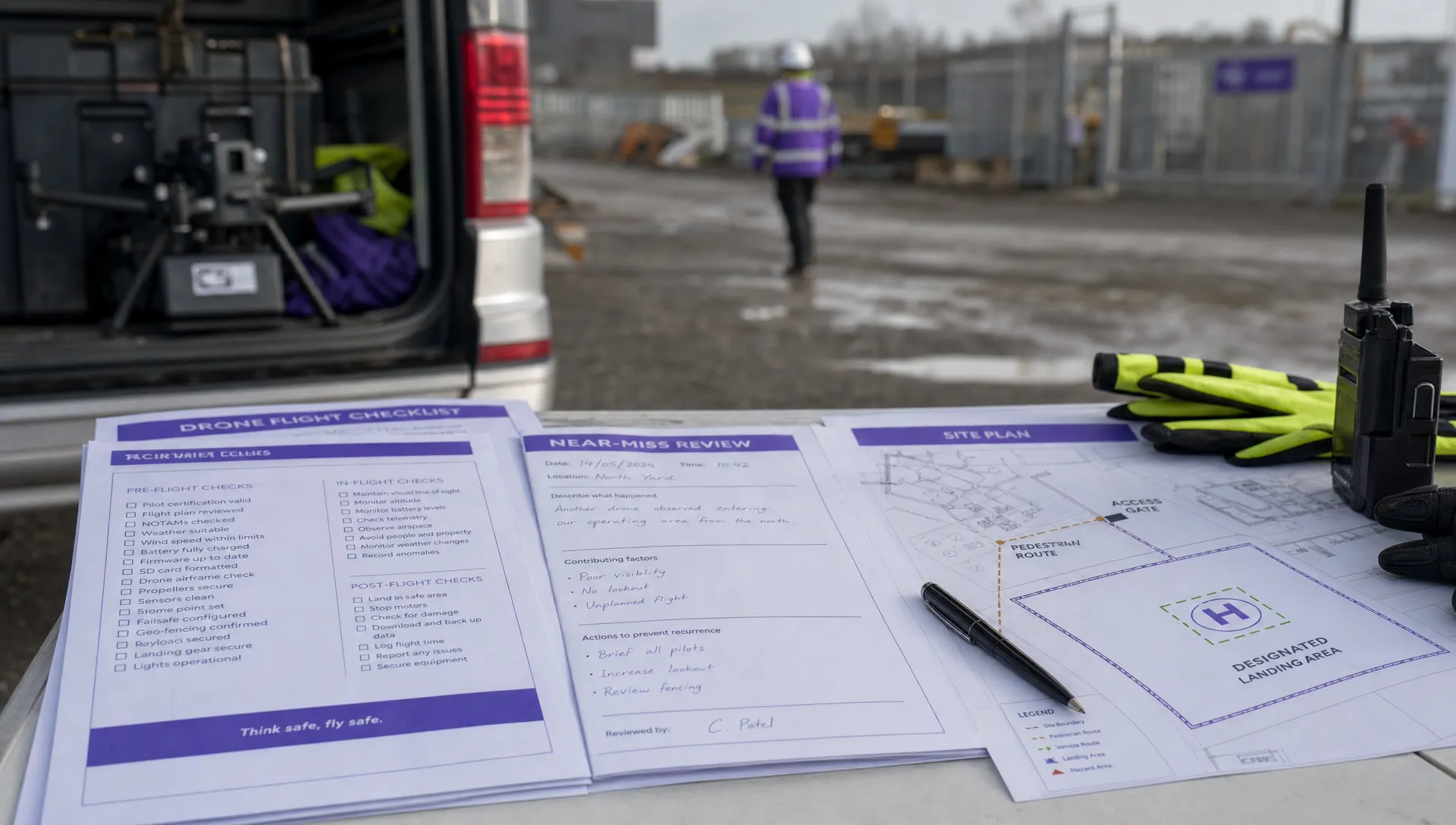
Record the event while memories are fresh. Capture the location, aircraft configuration, people involved, conditions and the sequence immediately before the near miss. Preserve original flight records, photographs and relevant communications rather than relying on a rewritten summary.
Ask crew members for their accounts separately before holding a group discussion. This helps retain differences in what each person saw or understood. Separate observations, such as “the gate opened during the inspection”, from interpretations, such as “the observer was distracted”.
Evidence should determine the changes to drone flight checklists, rather than the first explanation offered during the debrief. For DJI flight log analysis, consider Dronedesk’s DJI flight log analysis tool as part of your evidence review. Check aircraft records against witness accounts; logs alone cannot establish what people understood or whether access arrangements worked.
Assign someone to check whether external reporting or other escalation is needed. Keep that task separate from the checklist revision so neither process waits for the other.
2. Find the failed control, not just the last mistake
Reconstruct a short timeline: what was planned, what changed, what the crew noticed and what prevented the event becoming an accident. Include the recovery action, because it may reveal a control worth retaining.
For example, imagine a utility inspection in which a contractor opens a gate into an area the crew expected to remain clear. An observer spots the person and the pilot lands. This is a hypothetical example, not a reported incident.
“Check for people” would be a weak response. The review needs to establish whether the gate was inspected, whether anyone controlled access and whether the crew knew that contractors could enter during the work.
Use a compact failure analysis:
| Review question | What the answer helps establish |
|---|---|
| Was the hazard anticipated? | Whether planning covered the actual site activity |
| Was a suitable control defined? | Whether the plan specified something workable |
| Was the control implemented? | Whether responsibility and resources were clear |
| Did conditions change afterwards? | Whether monitoring and rechecking were adequate |
| Was the warning understood? | Whether communication and response arrangements worked |
This distinction matters when updating drone flight checklists: a missing instruction needs different treatment from an instruction that was impractical, misunderstood or skipped.
3. Decide whether a checklist change is actually the right fix
Some findings belong elsewhere. A defective battery needs an equipment response. A pilot unfamiliar with a flight mode needs training. Uncontrolled site access may require a different work arrangement, not another tick box.
Use the checklist to verify that a control is in place, rather than expecting the checklist to create that control. “Access arrangements confirmed” is meaningless if nobody has agreed those arrangements with the site contact.
Assign each corrective action to the document or process that governs it. That may be the site plan, equipment inspection procedure, crew briefing or risk assessment. If the event exposed an unrecognised hazard, revisit the flight risk assessment as well as the checklist.
For every proposed addition, ask whether it would have interrupted the actual sequence of events. If not, it probably does not address the finding. Also check whether an existing item can be clarified or replaced before adding another line that crews must work through.
4. Rewrite drone flight checklists as observable decisions
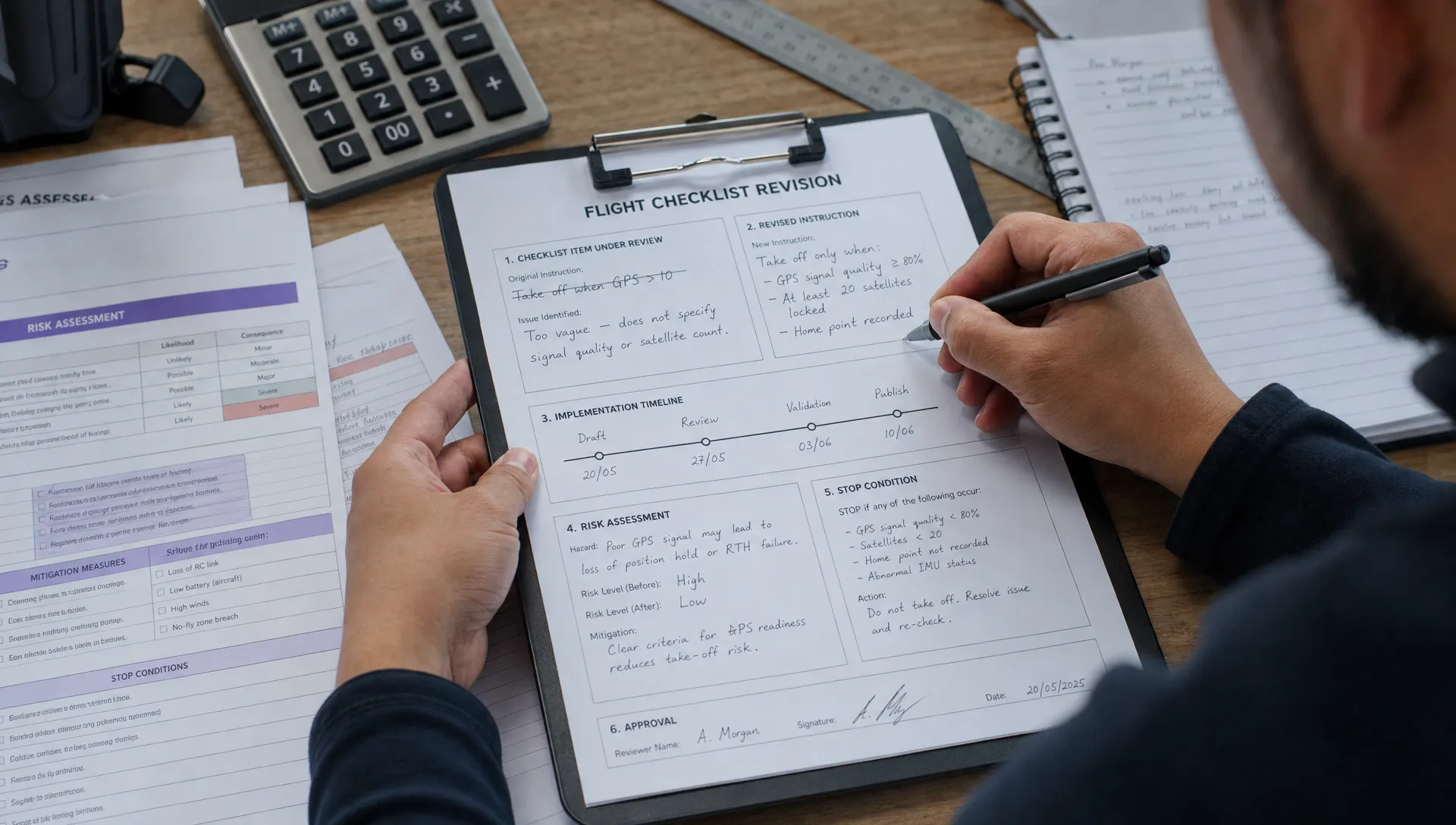
A useful checklist item tells someone what to verify, when to verify it and what happens if the result is unacceptable. Avoid instructions such as “ensure safety” or “check surroundings”. They do not define a completion standard.
Use this writing pattern: At this point in the operation, this person verifies this condition using this evidence; if it is not met, take this action. Shorten the wording for field use once the full meaning is agreed.
Worked example: unexpected access during an inspection
The following revisions illustrate how the gate-access scenario could inform a checklist. They are not a universal operating procedure.
| Weak wording | More useful wording | Hold or stop condition |
|---|---|---|
| Check site access | Before launch, the nominated crew member confirms access arrangements with the site contact and inspects agreed entry points | Hold launch if arrangements are unconfirmed or cannot be maintained |
| Brief observer | Pilot and observer confirm who monitors the access point and repeat back the agreed warning call | Hold launch if responsibility or the call is unclear |
| Check landing area | Confirm the planned landing area remains available under the current site activity | Resolve any obstruction before launch |
| Monitor surroundings | Recheck access arrangements after a crew handover or relevant site change | Pause the task and reassess if the original arrangements no longer apply |
Keep aircraft-specific limits and technical settings consistent with the relevant manufacturer instructions and approved team procedures. Do not invent a generic wind, battery or separation threshold simply to make a checklist item measurable.
5. Test the revision without recreating the hazard
Revised drone flight checklists need a practical test before general use. A desk review can catch missing words, but a controlled walkthrough shows whether the item appears at the right moment and whether its meaning is clear.
Use a tabletop exercise or ground-based rehearsal. In the access example, describe a gate opening after the pre-flight check and ask each crew member what they would do. Do not introduce an unsuspecting person into a live flight area to make the test realistic.
Ask a pilot who did not write the amendment to use it without coaching. Observe whether they can identify the responsible person, find the necessary evidence and explain the hold condition. If the author has to explain the wording, revise it.
Test relevant variants too: a crew handover, a different aircraft or a time-pressured deployment. Emergency services teams should test how an interruption affects checklist completion and what must be rechecked before continuing. A shorter time-sensitive procedure needs deliberate design, not informal omissions.
Record the test outcome and unresolved points. “Reviewed by the team” is less useful than noting exactly which scenario was tested and what changed afterwards.
6. Approve the change and remove competing versions
A well-written revision can still fail if half the team uses the previous version. Treat the amendment as a controlled operational change, not an edited attachment sent around by email.
Give it a version identifier, approval owner and effective date. Link it to the near-miss record so a later reviewer can understand why the wording exists. Record which aircraft, task types or operating conditions it covers; a site-specific lesson should not automatically become a fleet-wide requirement.
Brief affected personnel on the reason for the change and demonstrate the new decision point. Acknowledging receipt of a document does not show that someone knows when to stop a task.
Replace obsolete field copies and review downloaded PDFs, printed packs and local templates. Check arrangements with subcontractors if they use your procedures. Keep the old version in the archive, clearly marked as superseded, rather than leaving it available for normal use.
The release is complete only when crews can identify which drone flight checklists apply to their next job. If temporary instructions are needed before a permanent revision is ready, give them an owner and an expiry or review date so they do not remain in use indefinitely.
7. Check whether the revised control works in the field
Set a review point before issuing the amendment. Choose an initial sample of relevant jobs based on exposure to the hazard, rather than assuming a particular number of flights will prove effectiveness.
For the gate-access example, review jobs where third-party access could actually occur. Ten flights at an isolated site would tell you little about whether the change works at an active depot.
Look beyond completion ticks. During observation or debrief, establish whether the access agreement existed, whether the nominated person could maintain awareness and whether a site change triggered reassessment. Record cases where a crew held a launch or paused work because the condition was not met.
The absence of another near miss is not enough by itself. The hazardous situation may not have recurred, or people may have stopped reporting it. Ask crews whether the revised wording is usable and whether the new task competes with another responsibility.
Review drone flight checklists again if the control is routinely bypassed, produces inconsistent interpretations or requires attention the crew cannot realistically provide. That may indicate a need to redesign the operation rather than strengthen the wording. Close the action only when you have evidence that the control can be applied as intended.
Keep a short, traceable change record
The review record should explain the decision without forcing someone to reconstruct it from messages. A compact template is usually sufficient:
| Field | What to record |
|---|---|
| Event reference | Near-miss identifier and date |
| Finding | What failed, supported by the available evidence |
| Corrective action | The operational change, including any non-checklist action |
| Checklist amendment | Previous wording, replacement wording and its position |
| Scope and ownership | Affected tasks, responsible person and approver |
| Validation | Test scenario, participants and outcome |
| Release | Version, effective date and briefing arrangements |
| Follow-up | Review point, evidence required and closure decision |
Keep sensitive personal information out of broadly circulated briefing material unless it is needed. The operational lesson should be understandable without naming or blaming an individual.
This record also helps prevent gradual clutter in drone flight checklists. When someone later asks why an item exists, the team can assess its purpose and evidence rather than retaining it simply because it has always been there.
Frequently asked questions
Should every near miss produce a new checklist item? No. The appropriate response might be equipment repair, training, a revised site plan or clearer responsibility. Add or change an item only when it verifies a control that can interrupt the failure sequence.
When should the updated checklist take effect? Resolve immediate safety concerns before repeating the affected operation. Release the permanent revision once its wording, ownership and practical application have been checked. Do not let an unfinished document become a reason to repeat a known problem.
Who should approve changes to drone flight checklists? Use the approval responsibility defined in your organisation’s procedures. Include input from people who perform the task and involve a suitably knowledgeable reviewer where aircraft configuration or technical limits are affected.
What if crews keep skipping the new item? Investigate why. It may appear at the wrong stage, duplicate another check or require information unavailable on site. Observe the task before assuming that reminders or disciplinary action will solve the problem.
Put the revised process into use
Choose the most recent near miss and trace one finding through to a tested control, an issued checklist and a scheduled effectiveness review. That gives the team a complete example to repeat.
If you are reviewing how to manage the resulting operational records, compare your requirements with the Dronedesk features page. Use your revised checklist and change record to assess fit, rather than choosing a system before defining the process.
 How to Update Drone Flight Checklists After a Near Miss →
 FAA Drone Regulations for Commercial Use in Paid Training →
 What a Drone Line of Sight Waiver Means for Project Scope →
 Drone Regulations for Commercial Use With Mixed Aircraft Fleets →
 FAA 107 Test Study Plans for Shift Workers →
 How to Match a DJI Flight Log to a Client Job →
 Drone Regulations Under 250 Grams for Mixed-Weight Fleets →
 Drone Safety Guidelines for Working Near Water →
 FAA Rules and Regulations for Drones on Shared Worksites →
 Drone Pilot 107 Refresher Training After a Career Break →