
Choosing Drones for Fire Departments Beyond Thermal Imaging
A thermal camera can reveal temperature differences, but choosing drones for fire departments requires a wider assessment. The aircraft must reach a useful viewpoint, deliver information the incident commander can interpret and remain supportable across shifts. A capable sensor offers little value if the video feed fails at the command vehicle or nobody on duty can operate the system.
Treat procurement as the purchase of an operational capability, not an aircraft. Start with the decisions crews need to make, then assess the equipment, staffing and procedures needed to support them.
Define the decisions before writing the specification
A useful requirement describes an operational question. “Identify whether fire is spreading towards an adjacent roof” gives suppliers something more meaningful to demonstrate than “provide a high-resolution thermal camera”.
Ask incident commanders which information is difficult to obtain using existing methods. That might include the condition of an inaccessible elevation, the location of a vegetation fire boundary or the safest approach to an unstable structure. Record who needs each observation and how quickly it must reach them.
Separate essential tasks from occasional requests. A service mainly attending urban building fires may value rapid deployment and dependable optical zoom more than mapping large areas. A service covering extensive rural terrain may place greater weight on endurance and battery support.
The most useful specification for drones for fire departments connects every requested capability to a decision, a responsible person and a practical acceptance test. Avoid paying for payloads simply because they appear in another service’s equipment list.
Match the system to your incident mix
Different incidents expose different weaknesses. A demonstration over an open field will not establish whether a system works beside a warehouse, across broken terrain or near an incident command vehicle surrounded by radio equipment.
| Incident type | Useful information | Procurement question |
|---|---|---|
| Building fire | Roof conditions, external fire spread and inaccessible elevations | Can command distinguish relevant features without relying on temperature alone? |
| Wildland fire | Fire edges, access routes and nearby exposures | Can crews maintain useful coverage with the available batteries and launch sites? |
| Hazardous-material incident | Container markings, visible damage and approach conditions | Can optical zoom provide the required detail from a safe stand-off position? |
| Search and rescue | Search coverage and observations requiring ground-team checks | Can the system support a repeatable search and record areas examined? |
| Post-incident assessment | External damage and repeatable overview imagery | Can images be organised and handed over with their context intact? |
During structural incidents, an aerial view can support command decisions but cannot establish that a building is safe to enter. Likewise, a thermal observation during a search needs confirmation rather than being treated automatically as a person.
When comparing drones for fire departments, require demonstrations that resemble your common incidents. Include the conditions most likely to prevent useful information reaching command, rather than testing only under favourable conditions.
Assess the sensor package, not just the thermal resolution
Thermal imaging measures infrared radiation reaching the camera. It does not see through walls or establish structural stability. Reflections, surface materials, viewing angle and environmental conditions can affect interpretation. An apparent temperature should not become an operational conclusion without context.
Ask operators to explain what they can identify at realistic working distances. Thermal resolution alone does not describe that performance: lens choice, target size and image processing also matter. If temperature measurements are required, assess the radiometric workflow and its limitations separately from hotspot detection.
A good daylight camera can be equally valuable. Optical zoom may help crews inspect roof details or read markings without moving the aircraft closer. Digital enlargement cannot recover detail that the sensor never captured.
Other payloads need a defined purpose. A spotlight may support a particular search task, while a loudspeaker needs an agreed communication procedure. Specialist gas sensing requires a validated sampling method; carrying a detector does not automatically produce representative measurements.
The sensor package on drones for fire departments should therefore be tested against recognisable targets and decisions. Ask evaluators to record what they can identify, their confidence and what would still require ground confirmation.
Test the aircraft under realistic operating conditions
Published endurance is not the same as useful time over an incident. Account for launch preparation, travel to the observation position, wind, payload and the reserve needed to recover safely. Compare aircraft using the same representative mission rather than their longest advertised flight times.
Weather resistance also needs careful interpretation. Check the manufacturer’s stated operating limits and exclusions. An ingress-protection rating is not evidence that an aircraft tolerates fire plume heat, corrosive contamination or every combination of rain and wind.
Assess launch-site requirements, transport and handling with the equipment crews actually wear. Can the case be carried with other response equipment? Can a battery change be completed without putting components on contaminated ground? Are labels and controls readable during a night exercise?
For drones for fire departments, maintainability deserves the same attention as flight performance. Establish inspection intervals, repair arrangements and the consequences of losing the only aircraft or controller.
Ordinary aircraft should not be assumed suitable for an explosive atmosphere. Keep equipment outside hazardous areas unless its suitability and the operating method have been established through the service’s specialist assessment. Plan how contaminated equipment would be isolated, assessed and returned to service.
Make live video useful at the command point
A stable aircraft-to-controller connection does not guarantee a usable picture at the incident command vehicle. The onward connection may depend on mobile coverage, local networking, cables or a separate transmission system. Test the complete path.
Commanders need to know what they are seeing. The feed should have enough context to distinguish locations and understand the viewing direction. A close-up without an agreed location reference can create confusion, especially when several crews report different elevations of the same building.
Measure delay using the actual setup. Agree how the operator communicates a frozen image, lost connection or change of viewpoint. Avoid letting a silent display failure look like an unchanged scene.
For drones for fire departments, communications testing should include a deliberate loss of the onward video feed. The team should demonstrate how it reports observations and whether continuing the flight still serves a useful purpose.
Also test the receiving equipment in its intended location. Screen visibility, access controls and the workload placed on command staff matter as much as whether a supplier can stream a picture to a phone.
Build staffing and training around shift cover
A programme built around one enthusiastic pilot is vulnerable to leave, sickness and changes of role. Assess availability by watch or shift, including who can authorise deployment and who provides relief during a prolonged incident.
Assign responsibilities before an exercise. Depending on the task and risk assessment, these may include piloting, airspace observation, interpreting imagery and passing information to command. Avoid designing a workflow that expects one person to perform every task simultaneously.
Training should cover more than handling the aircraft. Crews need practice interpreting uncertain thermal observations, recognising misleading reflections and reporting information without overstating confidence. Include interrupted launches, lost communications and a request to recover immediately.
Use exercises to establish when not to deploy. A flight that distracts staff without answering a useful question consumes response capacity. Operators should be comfortable recommending a ground observation or another existing method instead.
Keep competence records linked to the work people actually perform. Familiarity with one aircraft or payload does not demonstrate readiness for every system, and occasional flying may not maintain the skills needed for difficult incident conditions.
Confirm the UK operating arrangements before purchase
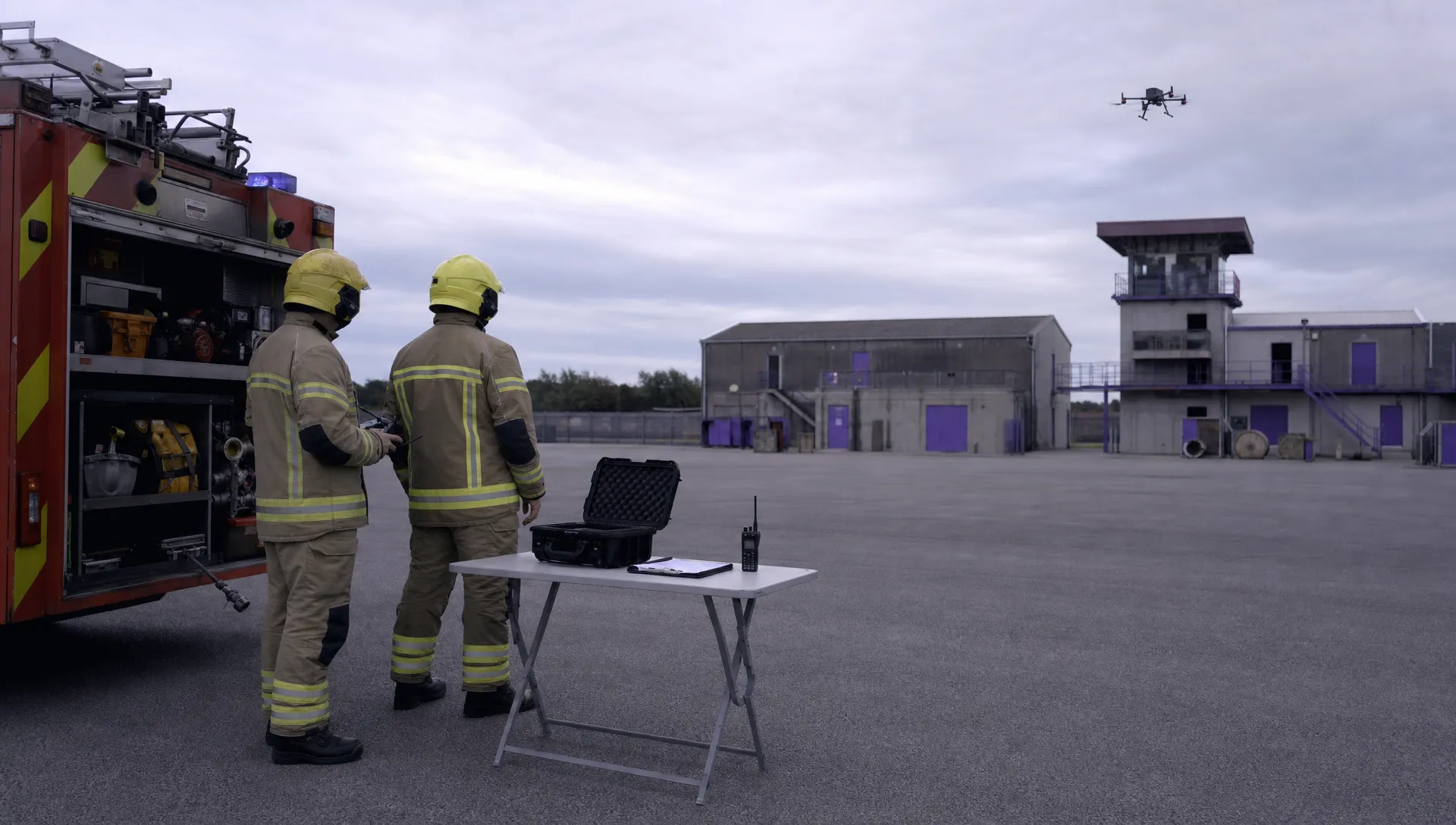
An aircraft demonstration does not establish that your service is ready to conduct the same operation. Before committing, have the aviation lead document the intended locations, operating distances, night work and any proposed remote-launch arrangements.
Check the proposed operation against the CAA’s current drone guidance and resolve questions about permissions through the appropriate official channels. Require suppliers to distinguish aircraft capability from the permissions and procedures your service would need. Do not build a response-time promise around arrangements that have not been confirmed.
Safe deployment of drones for fire departments also depends on coordination with other aircraft at the incident. Establish who manages that communication and how the drone team receives an immediate instruction to stop or recover.
Exercise the arrival of a crewed aircraft while a drone is operating. Test the notification route and recovery procedure rather than assuming the pilot will hear the relevant radio traffic. Record the point at which drone operations can resume and who makes that decision under the agreed incident arrangements.
Set footage and record-handling requirements early
Incident imagery can capture casualties, private property and sensitive operational details. Decide what needs to be recorded, who may view it and how sharing requests will be handled before the system enters service. Have the service’s information-governance lead review the proposed workflow.
Ask suppliers where recordings and account data are processed, which organisations can access them and whether essential functions depend on external cloud services. Test access removal when someone changes role. A shared login may be convenient during a demonstration but makes accountability harder.
Set retention arrangements by record type and purpose rather than keeping everything indefinitely. Preserve original material and its context when it may be needed for an investigation, following the service’s evidence procedures.
Procurement of drones for fire departments should include the handling of operational records as well as video. Distinguish aircraft flight logs, maintenance records and incident observations, since they answer different questions.
Where DJI flight records form part of your technical review, consider Dronedesk’s DJI flight log analysis tool during your assessment. Flight analysis can help examine aircraft behaviour, but it does not replace the incident narrative or explain every decision made by the crew.
Compare whole-life costs and measurable outcomes
The purchase price is only one part of the budget. Include payloads, spare batteries, charging, secure storage, connectivity, training time, maintenance and replacement cover. Check recurring software charges and the cost of exporting records or changing suppliers.
Compare at least two ownership arrangements where practical: a single station-based capability and a shared capability with defined availability. A lower equipment bill may be offset by travel, staff release or gaps in cover. A larger fleet adds its own inspection and competence workload.
Use the same measurement method during trials and after deployment. Record request-to-launch time separately from time to the first useful observation. Measure how often command received information that changed an action, rather than counting flight hours as evidence of value.
Include unsuccessful deployments. Weather-related cancellations, unavailable crews and unusable video feeds are part of the service’s actual readiness. Compare exercise results with existing observation methods before claiming an improvement.
The business case for drones for fire departments should state what improved, how it was measured and what it cost to maintain that capability. For the administration budget, this guide to assessing whether drone operations software is worth the cost offers a separate decision framework.
An acceptance test for drones for fire departments
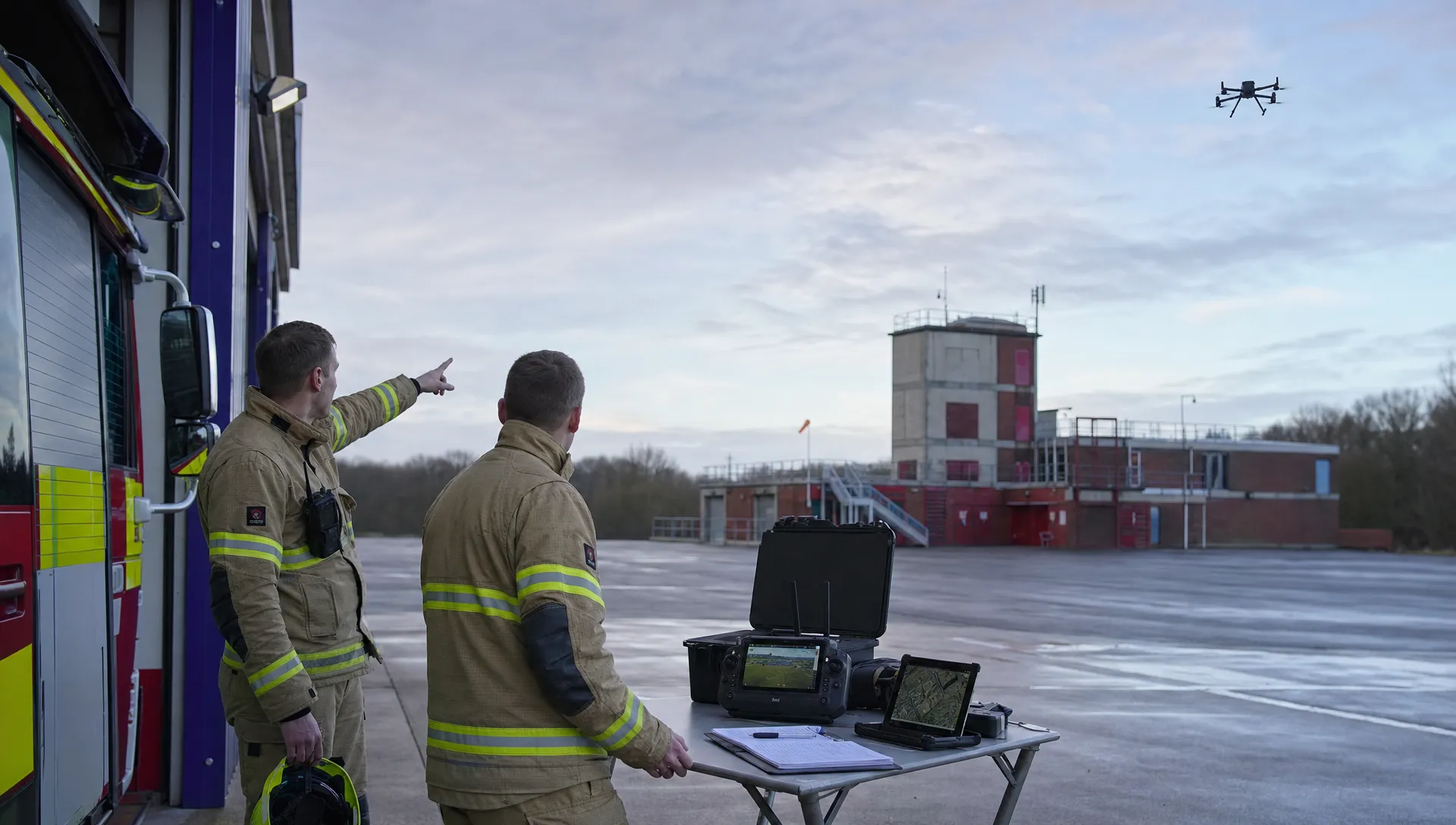
Ask shortlisted suppliers to complete the same scenario using the proposed production equipment. Agree pass criteria before the demonstration so a persuasive presentation cannot substitute for evidence.
A practical test should cover:
- Deployment by the intended crew, using the transport cases and equipment supplied.
- Identification of agreed visual and thermal targets at representative distances.
- Delivery of a usable picture and location context to the command point.
- Recovery following a simulated communications problem or airspace interruption.
- Export and handover of the required imagery and operational records.
Record setup time, operator workload and any assistance provided by the supplier. Repeat weak points rather than accepting an explanation that they will work differently after purchase.
A failed test does not always rule out an aircraft. It may identify a training need, an unsuitable communications design or a requirement that needs revision. Resolve the cause and retest before acceptance.
Frequently asked questions
Is thermal imaging enough for a fire service drone? No. It is one source of information. Optical imagery, dependable communications, suitable staffing and clear interpretation procedures determine whether that information helps command. Thermal cameras cannot establish occupancy or structural safety on their own.
Should a fire service buy the aircraft with the longest flight time? Only if endurance is the limiting factor in its intended missions. Compare useful observation time under the same conditions, including the payload, wind and recovery reserve. Battery-change arrangements and crew availability may matter more.
How many trained operators are needed? Base the number on shift coverage, expected workload, relief requirements and absence cover. Test whether the proposed staffing arrangement can support a prolonged incident without leaving other duties uncovered.
What is the best way to compare drones for fire departments? Run a common acceptance exercise with measurable criteria. Assess the information delivered to command, the complete video path, recovery procedures and record handling alongside aircraft performance. Include whole-life costs and support arrangements in the final decision.
Assess the supporting administration too
Once the operational requirements are clear, review Dronedesk’s published features against your service’s administration requirements. Bring your deployment workflow and record-handling criteria to that assessment, and ask for evidence against each requirement before committing. Select the supporting systems with the same care as the aircraft.
 Choosing Drones for Fire Departments Beyond Thermal Imaging →
 What Drone Safety Culture Looks Like in a Busy Operations Team →
 How Utility Drones Fit Into Planned Maintenance Programmes →
 How to Specify Drone Surveying Deliverables Before Hiring →
 Choosing Drones for Agricultural Use Beyond Crop Spraying →
 9 Drone Applications for Utility Asset Management →
 How to Write a Drone Business Plan That Tests Your Margins →
 How to Choose a Search and Rescue Drone for Rural Operations →
 How to Carry Out a Drone Site Survey Before Mobilising →
 How to Evaluate Drone Companies for Long-Term Contracts →