
Drone Regulations for Commercial Use With Mixed Aircraft Fleets
Drone regulations for commercial use become harder to manage when the aircraft assigned to a job can change. A compact camera drone, an RTK survey aircraft and a larger inspection platform may share an asset register, but they should not share unchecked assumptions about where, how or by whom they can be flown.
For survey teams, utilities and emergency services, the practical task is to connect each proposed flight with the right aircraft, pilot and supporting evidence. An organisation-wide checklist helps, but it cannot establish whether a particular aircraft configuration fits a particular operation.
This guide provides a verification workflow rather than reproducing legal limits or qualification thresholds. Use the linked official guidance to confirm current requirements, alongside the conditions of any approval you intend to use. The checks below are suggested internal controls, not a list of universal legal obligations.
Check drone regulations for commercial use against the jurisdiction
Start with the country where the flight will take place. Do not treat an aircraft’s approval history in one jurisdiction as evidence that the same operation is acceptable elsewhere.
For a UK-based organisation, the CAA’s drone guidance should be the starting point for identifying the applicable operating route, registration requirements and pilot competence requirements. Establish these before deciding which aircraft to send.
Teams working internationally should maintain separate jurisdiction records rather than copying a UK checklist and changing the location field.
| Planned location | Official starting point | Questions to resolve for the assigned aircraft |
|---|---|---|
| United Kingdom | CAA drone guidance | Which operating route applies, and what evidence supports this aircraft and flight? |
| An EASA member state | EASA’s explanation of European drone regulations | Which European requirements and national arrangements apply at the location? |
| United States | FAA Part 107 guidance | Is Part 107 the applicable route, and does the proposed flight need anything beyond it? |
Record the source, the date checked and the person responsible for the decision. A saved checklist without a traceable source makes later review harder, particularly when staff work across borders.
Build an aircraft-by-aircraft compliance matrix
A useful way to manage drone regulations for commercial use is to maintain an eligibility record for each aircraft, then test that record against each job. Avoid a single fleet-wide field labelled “commercially approved”. It conceals the conditions that made the original decision valid.
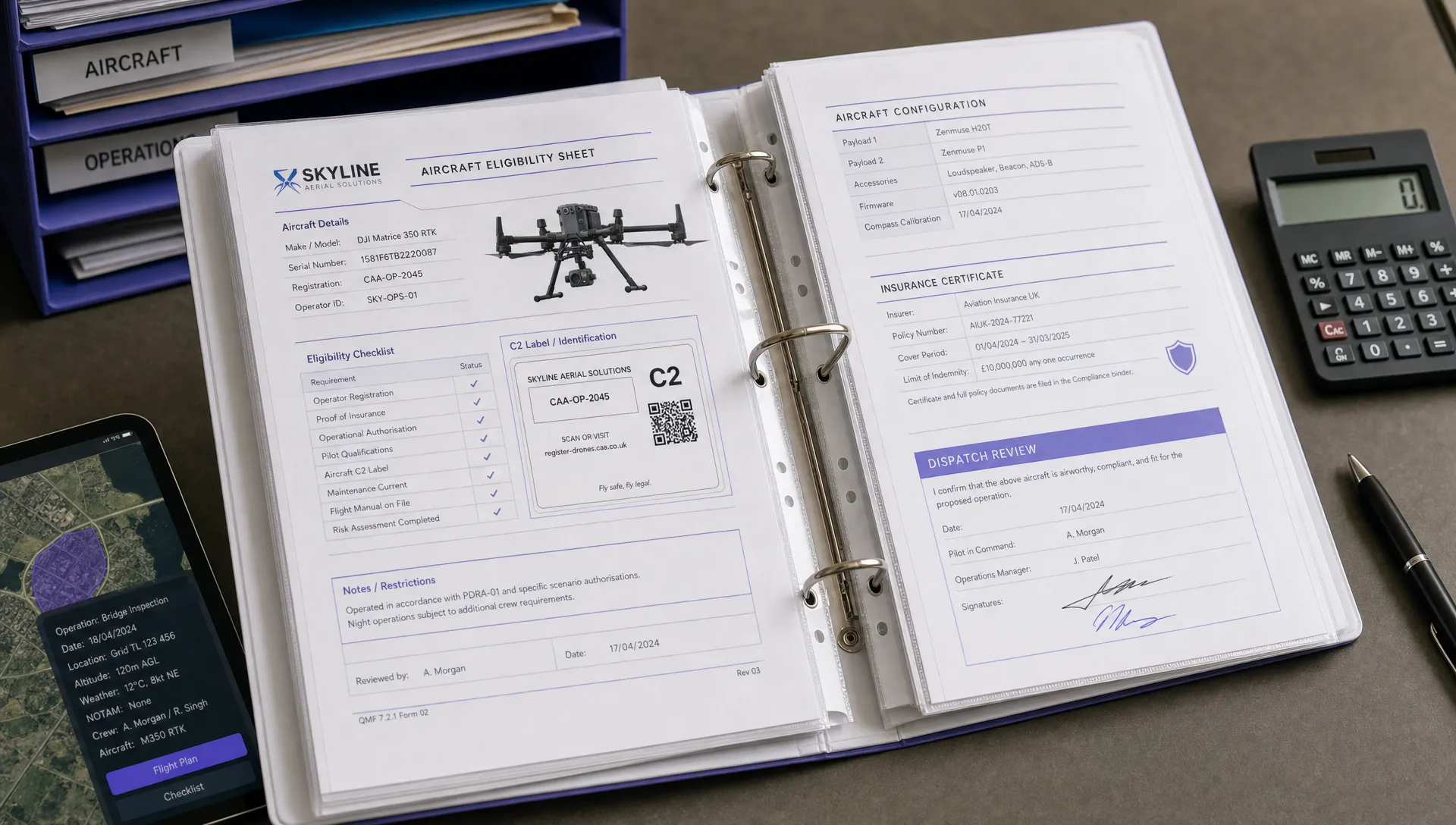
Separate the identity of the aircraft, its operating configuration and the evidence supporting its use.
| Record area | What to capture | What to verify before assignment |
|---|---|---|
| Aircraft identity | Model, serial number and internal asset reference | The aircraft selected matches the supporting documents |
| Configuration | Payload, batteries, attachments and relevant software version | The planned configuration matches the assessed one |
| Technical evidence | Relevant manufacturer documents, mass information and applicable marking evidence | The information belongs to this variant, not a similar product |
| Operating basis | Applicable category, declaration or authorisation documents, where relevant | The proposed flight fits the documented conditions |
| Pilot evidence | Qualifications, familiarisation and internal competency records | The assigned pilot meets the requirements identified for the job |
| Insurance | Policy documents and relevant aircraft or activity details | The planned aircraft and work fit the policy terms |
| Change history | Changes, review dates and responsible reviewer | No unresolved change affects eligibility |
Use “not assessed” where evidence is missing. A blank cell can otherwise be mistaken for “not applicable”.
For the wider asset-management process, Dronedesk’s drone fleet management guide provides a separate reference. Keep the regulatory decision record distinct from routine asset availability.
Record the configured aircraft, not just the model
The model name is only the starting point. An aircraft fitted with a different sensor, battery arrangement or attachment deserves a configuration review before dispatch. Assess whether the change affects the information used to approve the job, rather than assuming every change has the same consequence.
When applying drone regulations for commercial use, document the configuration you actually intend to fly. Do not substitute a manufacturer’s headline specification for evidence about the relevant variant and loadout.
For example, an inspection team might approve a particular aircraft with a thermal payload for one task. A later request to fit another sensor should prompt a check of mass, handling considerations and the scope of supporting documents. It does not automatically mean a new regulatory application is needed, but it does mean the earlier decision needs reviewing.
Give each assessed configuration a clear identifier. That makes “use the approved setup” an actionable instruction rather than a conversation dependent on somebody’s memory.
Match the pilot and aircraft to the actual job
Aircraft eligibility alone does not complete a dispatch decision. Review the assigned pilot’s evidence against the operation and equipment selected.
Keep regulatory competence separate from internal familiarisation. A qualification document and a record of experience with a particular aircraft answer different questions. Your dispatch process should show which evidence was checked for each.
The job record also needs enough detail to expose differences between apparently similar assignments. Record the location, intended flight profile, people nearby, access arrangements and relevant airspace information. Add any conditions in the documents supporting the operation.
For emergency services, prepare this structure before an urgent deployment. A pre-agreed review process is more useful than trying to reconstruct aircraft eligibility under time pressure. Do not assume the urgency of a task resolves an unanswered permission question.
The practical test for drone regulations for commercial use is whether the selected pilot, aircraft configuration and proposed flight fit together. A valid document somewhere in the organisation is not enough to answer that question.
Make substitutions a controlled decision
Aircraft substitutions are an easy place for a sound plan to become incomplete. The replacement may be available and technically capable, yet differ in ways that affect the original assessment.
Treat a substitution as an internal review trigger. Compare the replacement’s configuration, supporting evidence and pilot requirements with the job already planned. Then decide whether the existing assessment remains suitable, needs revision or requires advice before proceeding.
This is not a claim that every aircraft swap needs a new application to a regulator. Whether external approval is needed depends on the applicable rules and the documents supporting the operation.
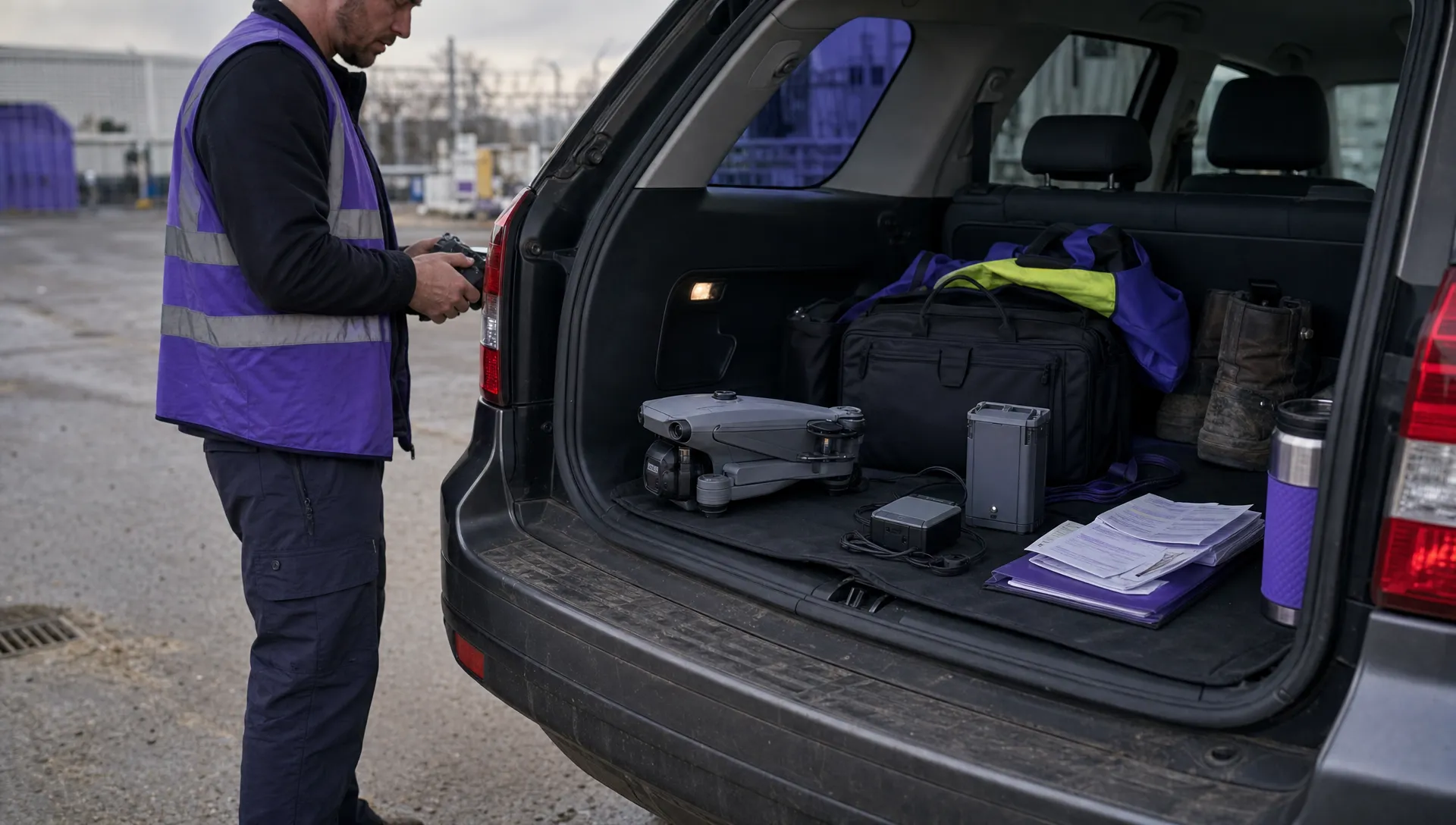
Record the replacement’s serial number and the reviewer’s decision. An instruction such as “take the spare” leaves too much room for uncertainty when several variants sit in the same equipment store.
Recheck the approval basis when the operation changes
A new aircraft can also introduce a different way of working. A dock-based deployment, a different observation arrangement or a substantially changed operating area should prompt a review of the proposed operation, not merely an update to the equipment list.
Compare the new proposal with the assumptions and conditions in your existing documents. Identify exactly what has changed and who is competent to assess the consequences. Keep unanswered questions visible rather than burying them in a general risk-assessment note.
Do not assume that an authorisation associated with one aircraft automatically extends to another. Equally, do not assume that every new model requires an entirely separate approval. Read the actual scope and confirm uncertain points with the issuing authority or a suitable adviser.
Where an application or amendment involves a SORA-based assessment, consult the CAA’s UK SORA material for the relevant official detail. The drone operations consultants directory lists vetted consultants who can support complex authorisation applications.
For these changes, drone regulations for commercial use should be checked against the complete proposed operation, not interpreted through a model comparison alone.
Keep planning evidence and flight records connected
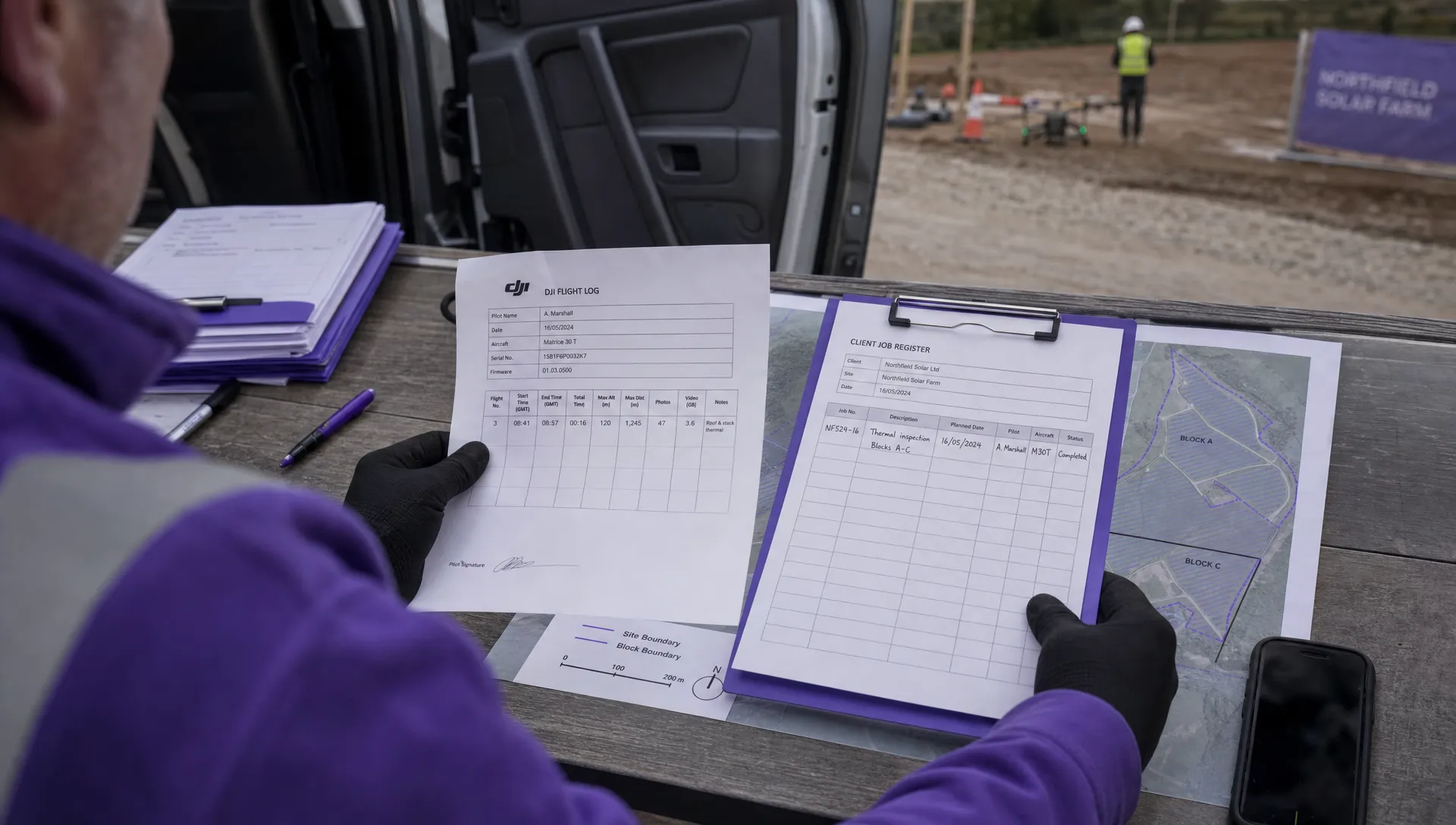
Your records should make it possible to reconstruct what was approved and what happened. Keep a clear connection between the job, aircraft serial number, configuration, pilot and version of the assessment used.
Separate planned information from recorded activity. A planned flight profile does not prove the aircraft followed it, while a flight log does not establish that the operation was permitted. Both can support a review, but they serve different purposes.
For DJI aircraft, the DJI flight log analysis tool is a relevant resource when reviewing flight records. Keep that analysis alongside the job’s planning evidence rather than treating it as a replacement for the approval record.
Record discrepancies and the action taken. If the aircraft used differs from the aircraft assigned, investigate the reason and whether the substitution review was completed. If a document was out of date, establish which decisions relied on it.
Keeping these records connected makes reviews of drone regulations for commercial use more specific. Instead of asking whether the fleet is compliant in general, a reviewer can examine the evidence for one aircraft on one job.
Worked example: a replacement aircraft for a utility inspection
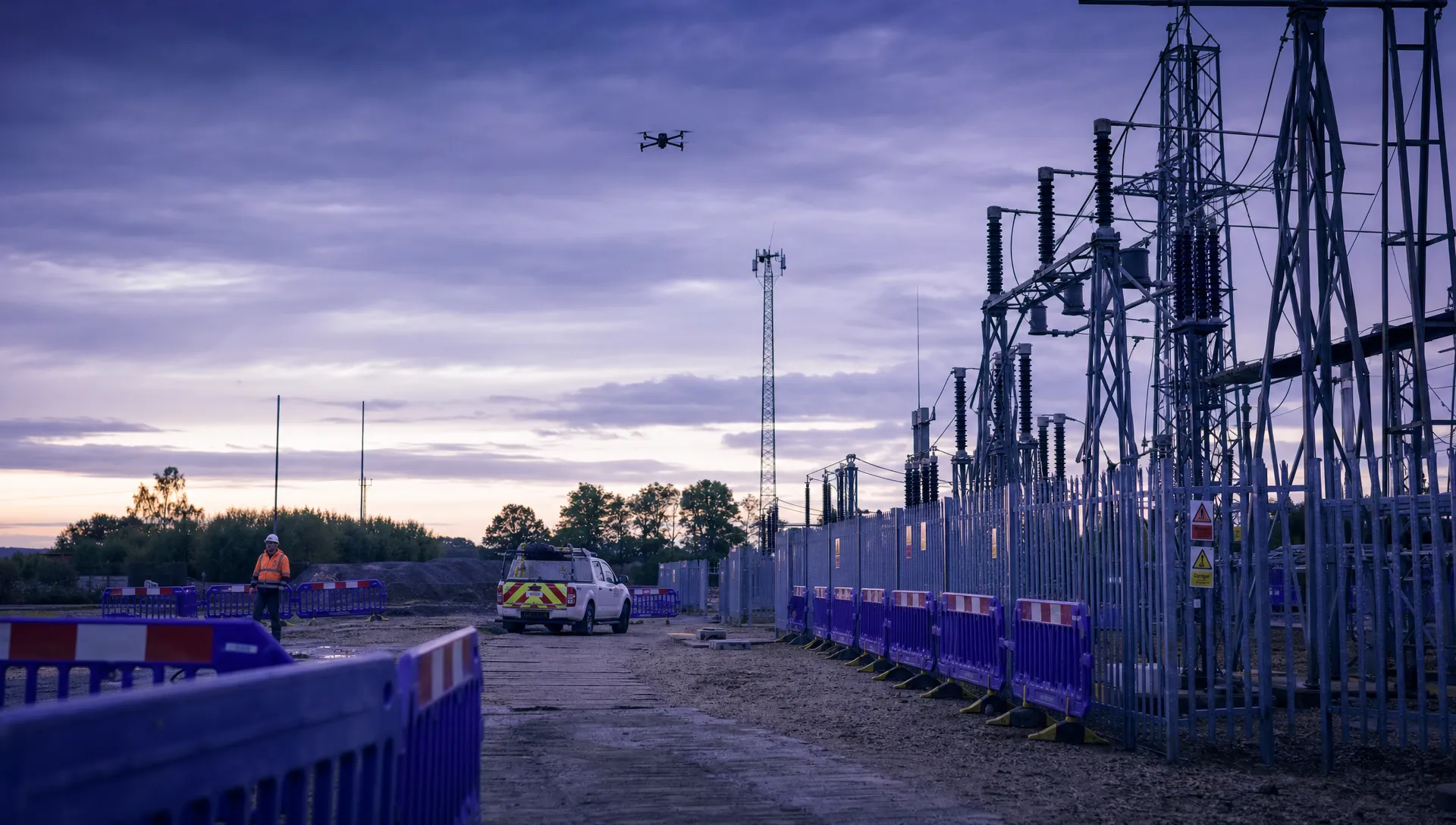
Consider a fictional utility team with a compact camera drone and a larger RTK inspection aircraft. The planned aircraft becomes unavailable before a site visit, and the team proposes using the other one.
The first check is the job itself: location, intended flight profile, people nearby and any conditions already identified. Next, the reviewer checks the replacement’s assessed configuration and supporting documents against those details.
The pilot assignment is reviewed separately. The team confirms both the applicable competence evidence and its own familiarisation requirements for the replacement. Insurance terms and relevant site arrangements are checked against the changed plan.
If the evidence supports the replacement, the team records the revised assignment and approval decision. If it does not, the response might be to alter the plan, obtain advice or postpone the flight. Technical capability alone does not settle the decision.
This is how drone regulations for commercial use become part of dispatch: the aircraft change produces a documented decision, rather than an assumption that everything in the fleet is interchangeable.
Frequently asked questions
Can one checklist cover a mixed drone fleet? A common checklist can cover shared administrative steps, but include aircraft-specific checks for configuration, supporting documents and pilot suitability. Make conditional items explicit so that a completed checklist does not hide an unanswered aircraft-specific question.
How far can a commercial drone fly? Do not use the manufacturer’s transmission range as the permitted operating distance. Check the applicable visibility requirements, airspace conditions and any approval terms for the proposed flight. Establish the limit for that operation rather than assigning one distance to the whole fleet.
Can a commercial drone operate near houses? Assess the actual location, aircraft and flight profile against current official guidance. Check the relevant arrangements for people, airspace, take-off and landing access, privacy and site restrictions. A residential address alone does not establish whether the proposed flight is acceptable.
Does adding a new drone mean every pilot needs another test? Identify the regulatory competence requirements for the intended operation, then assess aircraft familiarisation separately. For drone regulations for commercial use, neither “all pilots need another test” nor “existing qualifications cover everything” is a reliable fleet-wide assumption.
Put aircraft-specific checks into your workflow
Start with one planned job and two possible aircraft. Check whether your records let another reviewer establish which aircraft can be assigned, who can fly it and what evidence supports the decision.
If you are reviewing software to support that process, compare your requirements with Dronedesk’s published features. Keep responsibility for regulatory interpretation and dispatch decisions clearly assigned, whichever system you choose.
 Drone Regulations for Commercial Use With Mixed Aircraft Fleets →
 FAA 107 Test Study Plans for Shift Workers →
 How to Match a DJI Flight Log to a Client Job →
 Drone Regulations Under 250 Grams for Mixed-Weight Fleets →
 Drone Safety Guidelines for Working Near Water →
 FAA Rules and Regulations for Drones on Shared Worksites →
 Drone Pilot 107 Refresher Training After a Career Break →
 How to Track Drone Regulations Worldwide as a Business →
 FAA Rules for Flying Drones at Night During Emergency Missions →
 How to Onboard an FAA 107 Pilot for Utility Inspections →