
How to Evaluate Drone Companies for Long-Term Contracts
Choosing drone companies for a long-term contract requires more than comparing aircraft specifications and day rates. A supplier might produce an excellent demonstration yet struggle with repeat visits, consistent reporting or staff cover six months later. Your evaluation needs to test the operation behind the proposal.
For survey businesses, utilities and emergency services, the purchase is usually a dependable service: usable information, delivered within agreed conditions, with evidence that explains how the work was done. The aircraft is only part of that service.
Use the framework below to define the requirement, assess supporting evidence and test delivery before committing. It separates essential conditions from scored preferences, so a persuasive presentation cannot compensate for an unacceptable weakness. It also gives procurement and operational teams a shared basis for comparing bids.
Evaluate drone companies against the outcome you need
Start with the decision your organisation needs to make using the supplier's output. A utility may need defects located against asset identifiers. A survey company may need repeatable measurements in a specified coordinate system. An emergency service may need an available team that can operate effectively within its command arrangements.
Translate that outcome into a written service specification. Include the sites, expected frequency, operating conditions, deliverables and people who will accept the work. Identify dependencies such as access arrangements, landowner coordination or client-supplied asset information.
When comparing drone companies, distinguish the organisation selling the service from those actually delivering it. A manufacturer, software provider, reseller and flight operator offer different capabilities. An integrated proposal may involve several businesses, so establish who carries responsibility for each part.
Record the contracting entity, delivery locations and subcontracting arrangements. A UK sales office does not by itself establish where technical support, data processing or flight operations happen.
Your specification should also distinguish routine work from exceptions. Planned annual inspections, urgent call-outs and specialist investigations may need different staffing and pricing. Without those boundaries, suppliers can submit attractive bids based on incompatible assumptions, leaving the difficult decisions until after award. Ask each bidder to identify assumptions explicitly rather than burying them in its quotation.
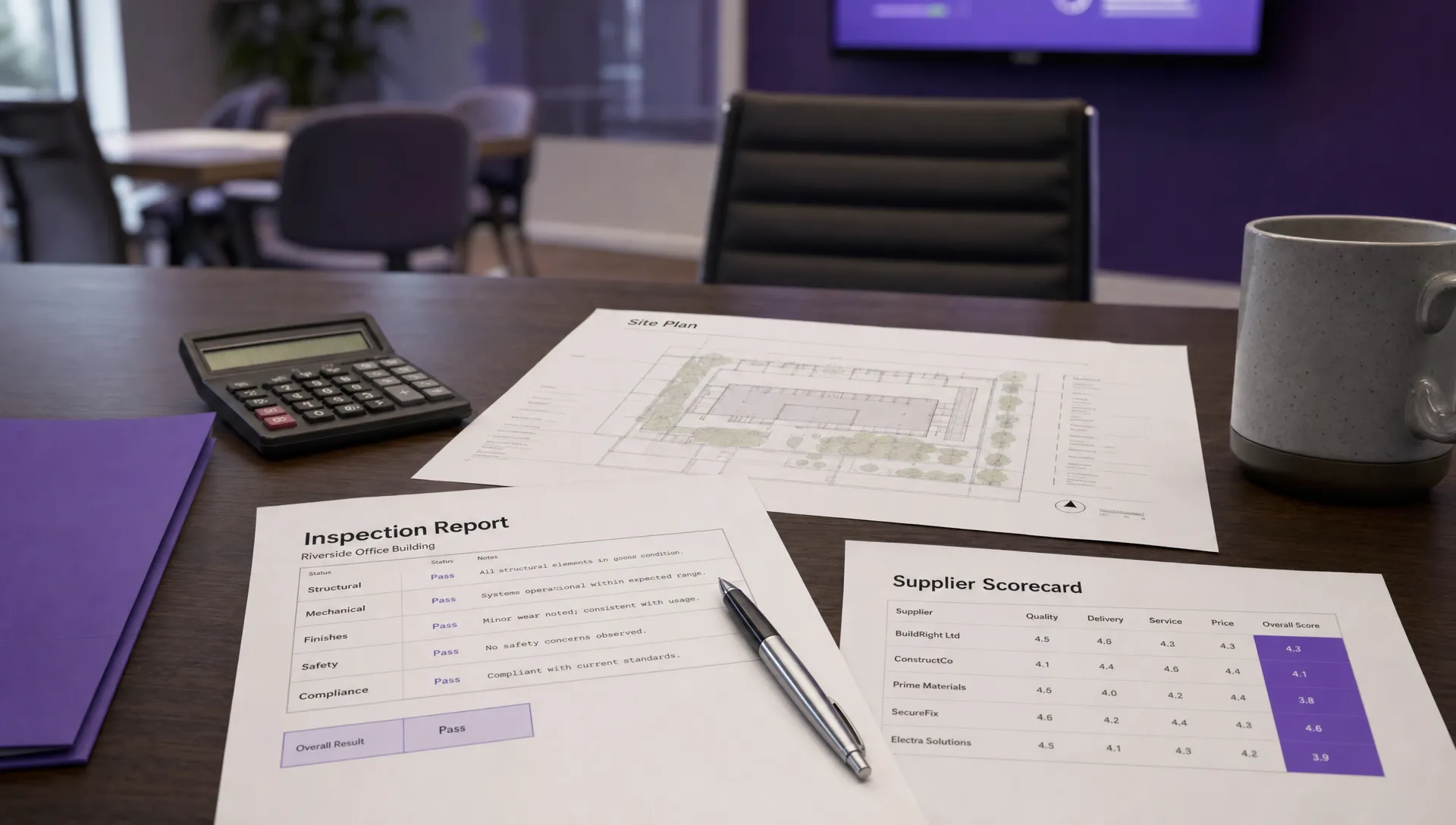
Build a weighted scorecard before requesting prices
Agree the assessment method before seeing proposals. Otherwise, an impressive demonstration can influence which criteria receive the most attention.
Use pass-or-fail conditions for matters you cannot trade away, such as satisfactory site-access arrangements, appropriate insurance evidence or acceptance of your data-handling requirements. Score the remaining criteria against a common scale.
This example weighting is a starting point, not an industry benchmark:
| Assessment area | Example weight | Evidence to examine |
|---|---|---|
| Technical delivery and data quality | 25% | Comparable outputs and validation results |
| Operational assurance | 25% | Site-specific planning and supporting records |
| Capacity and continuity | 15% | Named resources and credible backup arrangements |
| Information security and data control | 15% | Documented data flows and security evidence |
| Whole-contract cost | 15% | Complete pricing against a shared scenario |
| Contract management and exit | 5% | Reporting, escalation and handover proposals |
Score drone companies on evidence quality as well as the answer itself. A documented, successfully tested process deserves more confidence than a promise to develop one after award.
Define what each score means. For example, distinguish an unsupported assertion, a documented process and evidence of that process working on comparable assignments. Have operational and procurement reviewers score independently before discussing differences.
Keep written reasons for the final scores. They make moderation easier and help the contract manager understand which weaknesses need attention during mobilisation.
Verify delivery history at contract scale
A portfolio proves that work has been completed somewhere. It does not establish whether the supplier can sustain your proposed workload.
Ask for references that resemble the contract in frequency, geography and delivery complexity. A provider completing occasional roof surveys may have little evidence of managing simultaneous inspections across several regions. Equally, a large fleet does not prove competence in your specialist application.
Useful reference questions concern missed visits, rejected deliverables and how problems were resolved. Ask whether the same key people remained involved and whether invoicing matched the agreed scope. Speak to someone who accepted the outputs, not only the person who commissioned the work.
Established drone companies should be able to explain both successful delivery and the controls introduced after a failure. An account of a corrected problem can be more informative than an unqualified claim that nothing ever goes wrong.
Check commercial continuity too. Review available accounts, understand whether the contract would represent an unusually large share of the supplier's work and ask how mobilisation will be funded. Historic accounts alone cannot establish present financial health.
For a smaller specialist, assess practical resilience rather than excluding it automatically. A credible partnership or limited initial scope may address capacity concerns, provided responsibilities are explicit and the proposed arrangements can be demonstrated.
Check operational readiness for each site
Ask the proposed delivery team to explain how it would assess representative sites, including one with awkward access or operating constraints. A generic risk assessment provides less assurance than a worked example tied to your assignment.
For UK work, use the CAA's drone guidance to check current requirements directly. Ask bidders to identify the permissions and operational authorisations relevant to their proposal, then verify the supporting evidence against the intended work. Avoid treating a credential in a sales presentation as proof that every proposed assignment has been addressed.
Compare how drone companies handle changes after planning: an occupied work area, unexpected aircraft activity, deteriorating weather or an unavailable access point. Ask who can stop work and how the client receives the revised plan.
Request insurance documentation and check its scope against the activities being purchased. Discuss exclusions, subcontractor arrangements and any mismatch between policy wording and the proposed service with your insurance adviser.
For emergency services, test coordination through an agreed exercise rather than assuming general commercial experience transfers directly to incident work. Establish communication responsibilities, information-sharing arrangements and how the team will operate around other responders.
The assessment should reveal a usable decision process, including when the supplier will decline or postpone a task. Commercial pressure should not be the deciding factor in launch decisions.
Test data quality and acceptance criteria
Specify what makes a deliverable acceptable before asking for a demonstration. Attractive imagery is not an acceptance standard.
For mapping, distinguish image resolution from positional accuracy. A stated ground sampling distance does not establish the accuracy of the finished survey. Ask how results will be checked against independent reference information and how the supplier reports uncertainty.
For thermal inspections, examine the conditions under which observations were collected and how findings are interpreted. Equipment capability alone does not establish that a reported anomaly supports the maintenance decision you need to make.
For visual inspections, define coverage, asset identification, image usability and the method for identifying locations that could not be inspected. A complete-looking report can still leave gaps if inaccessible areas are not identified.
Ask shortlisted drone companies to submit a sample deliverable against your own acceptance checklist. Have the eventual users assess it, including the surveyor, asset engineer or incident team receiving the information.
Include file formats, naming conventions, metadata and delivery channels in the specification. Check that outputs can enter your existing systems without extensive manual rework.
Also agree how rejected work will be handled. Distinguish a genuine defect from a changed client requirement, specify the evidence needed to resolve disagreements and set a correction process. Preserve the original submission and revised version so acceptance decisions remain traceable. This matters more over a multi-year programme than the visual polish of a single demonstration report.
Examine capacity, resilience and supply chains
Request a resource plan for your expected peak workload, not the supplier's average week. It should identify the people, aircraft, payloads and processing capacity available when several jobs coincide.
Check whether backup equipment can produce equivalent outputs. A replacement aircraft may be available but lack the sensor, endurance or processing workflow needed for the assignment. Ask the supplier to demonstrate the proposed substitution rather than merely list spare equipment.
When assessing drone companies, test whether named staff and backup resources are genuinely available or shared across several competing commitments. Subcontractors should be identified, with their responsibilities and oversight explained.
Investigate repair arrangements, battery replacement, software dependencies and access to specialist parts. Ask what happens if a manufacturer stops supporting an aircraft or a required cloud service becomes unavailable.
For sensitive procurement, establish the origin of hardware and software, relevant support locations and compatibility with your organisation's purchasing policies. Do not assume that a familiar brand is automatically acceptable, or that an unfamiliar one is automatically unsuitable.
Dronedesk's drone fleet management guide provides further context for assessing how an expanding operation manages its resources. During procurement, require evidence that the supplier's arrangements work at the scale you are buying. Ask to see how equipment availability is reconciled with the forward work schedule.
Audit data handling and operational records
Map where information goes between capture and deletion. Include aircraft storage, memory cards, processing computers, cloud services, subcontractors and the final client repository.
Ask who can access each stage, how accounts are removed when staff leave and what happens after a suspected security incident. The NCSC's supply-chain security guidance offers a useful reference for structuring supplier questions.
Drone companies should be able to explain which operational records support each assignment and how those records can be retrieved. Review a completed example that connects the agreed scope, planning decisions, personnel, aircraft and delivered output.
Where flight logs form part of your evidence review, compare a sample with the associated job record and reported timings. The DJI flight log analysis tool can form part of that review for DJI records. Treat logs as one evidence source, not proof of the quality or completeness of the final deliverable.
Put data ownership, permitted reuse, retention and deletion arrangements into the contract. Clarify access to raw files as well as processed outputs, and distinguish your assignment data from the supplier's pre-existing intellectual property. Request a sample export before award so portability is demonstrated rather than promised.
Compare whole-contract cost, not day rates
Give every bidder the same workload scenario. Include mobilisation, planning, travel, data processing, reporting and the handling of unsuccessful visits.
The following fictional example shows why the headline rate can mislead. It assumes one flight day per visit, identical accepted outputs and all other costs being equal. Figures exclude VAT and are not market benchmarks.
| Cost component | Supplier A | Supplier B |
|---|---|---|
| Flight day | £900 | £1,050 |
| Processing and reporting per visit | £250 | £50 |
| Total per completed visit | £1,150 | £1,100 |
| Total for 24 completed visits | £27,600 | £26,400 |
Although Supplier A advertises the lower flight-day rate, Supplier B costs £1,200 less across this example programme.
Compare drone companies using a cost per accepted outcome where possible: a completed asset inspection or an accepted survey package, for example. Define the outcome carefully so that suppliers are not rewarded for reducing coverage or reporting detail.
Model exceptions separately. These might include weather-related postponements, denied access, urgent mobilisation or client-requested changes. Establish which party controls each cause and how charges will be approved.
For multi-year agreements, specify any price-review mechanism, minimum purchase commitments and additional storage or software charges. Ask procurement and finance to test a low-volume year as well as the expected workload. A favourable unit rate may depend on demand your organisation cannot guarantee.
Make service levels measurable and fair
Avoid a single promise such as a 24-hour response. It could mean acknowledging an email, providing a pilot, arriving on site or delivering usable information.
Define separate milestones for acknowledgement, planning, mobilisation, capture and accepted delivery. State when each clock starts, what pauses it and who records the evidence.
Reliable drone companies should be willing to agree measures they can control while identifying dependencies they cannot. Weather, client access and changes to the assignment need explicit treatment rather than being hidden in broad exclusions.
Keep safety decisions separate from incentives to complete a flight. A contract that penalises every postponement can encourage poor judgement. Measure the quality and timeliness of the decision, communication and recovery plan instead.
Include a reporting schedule and escalation contacts with authority to resolve problems. Service credits may support accountability, but repeated failure should also trigger a corrective-action process and, where agreed, termination rights.
Have your legal and commercial advisers review liability, intellectual property, confidentiality and dispute provisions. Ensure the final agreement reflects the operational proposal you evaluated, including its assumptions and exclusions. Otherwise, the assurance gained during selection may disappear when the service moves into delivery. Keep the accepted specification attached to the contract rather than relying on presentation slides or email recollections.
Run a paid pilot before awarding the full term
A paid pilot should test the service you intend to buy, not a simplified showcase. Choose a representative assignment with realistic access, reporting and acceptance conditions.
Use the proposed delivery team and normal workflow. If senior specialists provide additional support for the pilot, ask whether that support is included in the ongoing price.
Test shortlisted drone companies against predefined measures: planning quality, communication, deliverable acceptance and the effort required from your own staff. Record client time spent answering avoidable questions or repairing files, because that cost may otherwise remain invisible.
Include one controlled complication, such as a revised access window or a request to replace the nominated pilot. Do not manufacture unsafe conditions. The purpose is to see whether the operating process handles ordinary disruption.
Agree pilot payment, data rights and acceptance arrangements in advance. A successful trial should produce a written findings report, including weaknesses and actions required before mobilisation.
If the evidence is mixed, narrow the initial scope or use a staged award with review points. A longer commitment should follow demonstrated delivery rather than compensate for uncertainty. Set a deadline for resolving pilot findings and name the person who will verify completion. Avoid allowing unresolved actions to become routine exceptions once the full contract begins.
Review performance and plan a usable exit
Contract award is the start of supplier management. Assign an internal owner who understands both operational delivery and the commercial agreement.
Review a small set of meaningful measures: accepted deliverables, repeat visits caused by supplier error, delivery timeliness and unresolved corrective actions. Interpret them alongside workload and site difficulty so comparisons remain fair.
Assess drone companies throughout the term using the same evidence-led approach applied at selection. Revisit staffing, subcontracting, equipment changes and data-processing arrangements when they change, rather than waiting for the annual review.
Define how service improvements will be proposed and approved. A new sensor or processing method may be useful, but it should not change outputs or introduce unpriced dependencies without agreement.
Plan the exit before you need it. Specify which data and records will be handed over, their formats, the timetable and any transition charges. Test a sample handover while the working relationship is healthy.
Your organisation should be able to change supplier without losing access to its inspection history or having to reconstruct previous acceptance decisions. Retain enough internal knowledge to explain the specification, interpret the outputs and brief a replacement provider. Outsourcing delivery should not remove your ability to judge whether the service remains suitable.
Frequently asked questions
Should we choose a large supplier or a specialist operator? Choose according to the work and the evidence. A specialist may offer stronger technical expertise, while a larger provider may offer broader coverage. Test actual capacity, backup arrangements and comparable delivery rather than using company size as a substitute for assessment.
How many drone companies should reach the pilot stage? There is no universal number. Shortlist only suppliers that pass essential checks, then consider the cost and value of testing more than one. If you pilot a single preferred bidder, preserve the option to reject it when acceptance criteria are not met.
What is the strongest warning sign during evaluation? A mismatch between confident claims and missing evidence deserves investigation. Examples include unnamed delivery partners, unclear data-processing arrangements or refusal to define acceptance criteria. Give the supplier an opportunity to explain, then record whether the answer resolves the concern.
Should the cheapest compliant bid win? That depends on your agreed procurement method. Establish the method before assessment and account for processing, client administration, repeat visits and transition costs. A low day rate is not the same as a low cost for accepted work.
Prepare for evidence-led procurement
Before inviting proposals, agree the service specification, scorecard and pilot acceptance criteria with the people who will use the outputs. Those documents make bids easier to compare and give the eventual contract manager a practical starting point.
If you are preparing your own operation for supplier scrutiny, review Dronedesk's features against the planning and record-keeping requirements prospective clients ask you to demonstrate.
 How to Evaluate Drone Companies for Long-Term Contracts →
 What a First Responder Drone Programme Needs Before Deployment →
 Law Enforcement Drones and Their Role in Evidence Collection →
 What Are UAV Systems? Aircraft, Payloads and Ground Equipment →
 7 Best Flight Planning Apps for Commercial Drone Teams →
 How Police Drones Support Incident Command →
 FAA Drone Flight Regulations for Operations From Moving Vehicles →
 DJI Remote ID Compliance Checks When Renting Aircraft →
 What a Drone Site Selection Tool Can Miss About Ground Access →
 How to Brief Clients on Drone Restrictions Near Airports →