
Drone Safety Guidelines for Working Near Water
Water can look like an uncluttered place to fly, but it removes landing options and introduces hazards that are easy to miss from shore. Effective drone safety guidelines need to address reflections, wind over open water, changing tides and the safety of anyone tempted to retrieve a downed aircraft.
For survey teams, utility inspectors and emergency services, the aim is not simply to keep the drone dry. It is to preserve control, maintain a usable landing area and prevent an equipment problem from becoming a water-rescue incident. The following approach focuses on practical operational decisions rather than universal settings that may not suit your aircraft.
Assess the shoreline, not just the airspace
Begin with the purpose of the job and the minimum flight exposure needed to achieve it. A shoreline inspection may be possible from a landward route, while a reservoir survey might require longer over-water legs. Avoid extending the route over water merely because it appears free of obstacles.
Map the working area beyond the aircraft’s intended path. Include launch access, alternative landing areas, public footpaths, boat movements, overhead cables and locations where birds are gathering. Around utility sites, identify intakes, spillways, electrical equipment and structures that could affect positioning or communications.
Your assessment should distinguish three connected areas:
- The flight area: Where the aircraft will operate, including its route back and any likely drift after a fault.
- The crew area: Where people can work without exposure to unstable banks, wave wash, traffic or an unprotected edge.
- The recovery area: Where an aircraft could come down and whether recovery would require specialist assistance.
Write those decisions into your drone safety guidelines, including who can stop the operation and what makes the site unsuitable. A structured drone flight risk assessment helps turn observations into controls and stop conditions.
For UK work, check the CAA’s current drone guidance for the requirements relevant to the aircraft, location and intended operation. Airspace permissions and site access are separate planning questions; resolve both before deployment.
Apply drone safety guidelines to wind, tides and visibility
Conditions at the launch point may not represent conditions along the route. A sheltered harbour wall can conceal stronger wind outside the harbour, while cliffs and large structures can create turbulence. Wind direction matters as much as speed: an easy outbound leg may leave the aircraft fighting a headwind on its return.
Use a forecast relevant to the location, then compare it with observations on arrival. Watch for increasing gusts, whitecaps, spray reaching the working area and approaching rain or fog. Do not use surface appearance alone to estimate conditions at flight height.
Weather limits in your drone safety guidelines should reflect the aircraft documentation, the task and the crew’s ability to recover safely, not just the manufacturer’s maximum stated wind resistance. A maximum capability is not automatically a sensible operating target.
Tide and water-level changes also affect the crew. Check whether a rising tide could cover the landing area or cut off the walk back. On rivers and reservoirs, consider changing flows, scheduled releases and slippery access routes. Record the source and timing of any information supplied by a site operator.
Sun glare can make aircraft orientation difficult even when visibility otherwise appears good. Choose a pilot position that supports continuous observation without forcing someone to stand close to the water’s edge. If glare, mist or the background prevents reliable monitoring, change the plan or stop.
Prepare a dry, stable launch and landing area
Choose a location with firm footing, adequate clearance and enough room for an imperfect approach. Wet rocks, narrow pontoons and loose sand can create problems for both the aircraft and the person operating it. Keep cases, loose straps and other equipment away from the approach path.
A landing pad can help keep sand and debris away from the aircraft, but it does not make an exposed site safe. Confirm that the pad will remain secure and that the area will still be usable at the expected recovery time. Brief the team on where to stand and how to keep other people clear.
Where the assessment identifies a risk of entering the water, select suitable protection and rescue arrangements for the actual environment. Wearing flotation equipment does not make a dangerous bank or improvised retrieval acceptable.
Treat boat-based operations as a separate procedure
A vessel introduces movement, restricted deck space, rigging and changing separation from the aircraft. Establish who controls the vessel, who controls the drone and how they communicate before launch. Agree what happens if either person needs to stop the operation.
For boat work, drone safety guidelines need a recovery procedure that accounts for deck movement and the vessel’s position, rather than assuming the launch conditions will remain unchanged. Follow aircraft-specific instructions and the operator’s approved procedures where applicable.
Do not improvise hand-catching because the deck has become difficult to use. If there is no suitable, practised recovery method for the expected conditions, choose another launch arrangement or do not fly.
Understand what water can do to positioning and sensing
Reflective, transparent or low-texture surfaces can challenge vision-based positioning and distance sensing. The effect depends on the aircraft, sensor design, light and water conditions. Calm water is not necessarily easier than moving water, and a stable hover over land does not demonstrate reliable behaviour over the surface.
Use the manufacturer’s aircraft manuals to check warnings for the exact model, its sensor limitations and the meaning of height information shown to the pilot. Do not assume the displayed height is a direct measurement of clearance above the water. Understand its reference before using it for separation decisions.
Keep model-specific sensor cautions in your drone safety guidelines so pilots do not apply advice from a different aircraft. There is no universally safe over-water height, and disabling a sensing system is not a general solution. Changing settings without understanding the consequences can remove a useful protection elsewhere in the flight.
Establish normal control response and positioning in a suitable area before beginning the task. Watch for unexpected vertical movement, position drift or conflicting warnings. If behaviour becomes uncertain, prioritise separation from the surface and obstacles using the aircraft’s documented procedures, then recover when safe.
For inspections, choose the stand-off distance needed to obtain useful data without unnecessarily increasing exposure to spray, structures or birds. Stop or reroute if wildlife reacts to the aircraft.
Plan the return journey and battery reserve together
Return-to-home is a contingency function, not a substitute for route planning. Before take-off, confirm the recorded home point, the selected signal-loss response and the return path. Check how the aircraft will behave around obstacles and whether its settings remain suitable for the site.
A fixed home point may become unsuitable if a vessel moves or a shoreline landing area is lost. Some aircraft offer alternative home-point functions, but availability and behaviour vary. Confirm the exact function in the manual rather than assuming the aircraft will follow the controller or find the moving vessel.
Battery reserves in drone safety guidelines should reflect the return distance, wind, battery condition and time needed for a controlled landing. A single percentage threshold cannot account for all of these factors.
Set a turnaround decision before launch, then bring it forward if progress against the wind is poorer than expected. Avoid using the last part of the flight to investigate a warning, repeat an unnecessary inspection pass or search for a landing location.
Brief an alternative recovery location where one is genuinely available. If none exists, recognise that the operation has less tolerance for faults and adjust its extent accordingly. The plan should make an early return straightforward, not something the pilot has to negotiate after a problem develops.
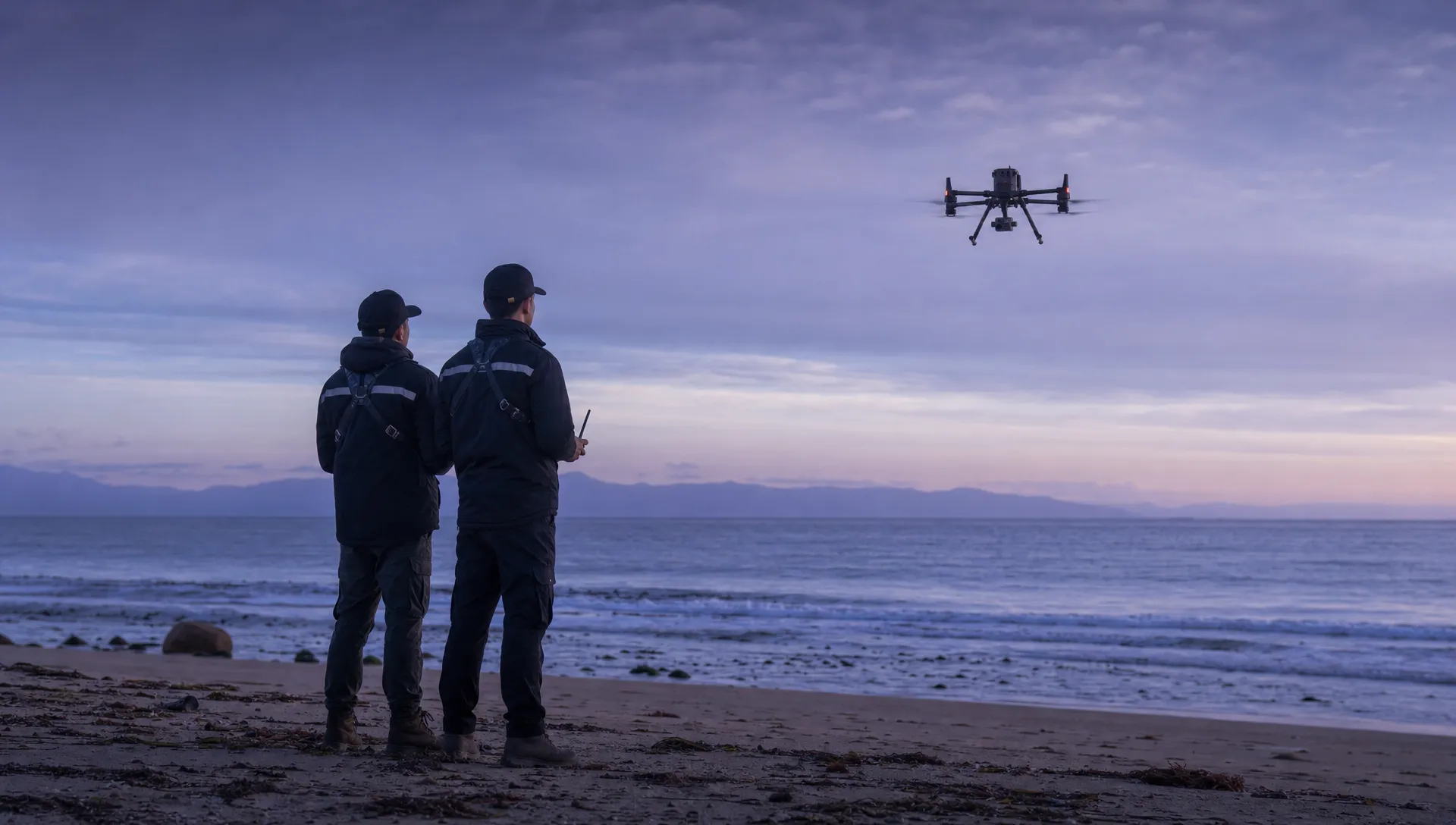
Define stop conditions before they happen
The pilot should not have to decide from scratch whether deteriorating conditions justify abandoning a task. Agree observable triggers during the briefing and give each crew member a clear way to call attention to danger.
| Observation | Planned response |
|---|---|
| The tide approaches the agreed access limit | Recover and leave before the route becomes unsafe |
| Spray or rain exceeds the aircraft’s documented operating conditions | End the task and recover using the safest available approach |
| Positioning or height behaviour becomes unexpected | Stop the inspection, establish safe separation and recover |
| A vessel or person enters the planned working area | Pause or reposition to preserve separation; recover if necessary |
| Return progress is poorer than planned | Turn back early rather than waiting for the normal battery trigger |
| A crew member loses safe footing or access | Prioritise crew safety and stop the operation |
These are planning examples, not numerical limits. Your briefing should identify the actual boundary, observation or warning that triggers action at that site.
Include crew exposure in the decision, not just aircraft performance. A drone may still be controllable while a landing area becomes unsafe for the person standing beside it.
Keep an aircraft loss from becoming a rescue incident
Include a no-entry rule for untrained retrieval in your drone safety guidelines. A floating aircraft or a visible position on a map can create pressure to act quickly, but neither makes cold water, currents or unstable banks safe.
If the aircraft enters the water, first account for everyone and prevent an impulsive entry. Record its last known location from a safe position and contact the relevant site operator or specialist recovery service where appropriate. If someone is in danger, contact the emergency services and follow their instructions.
If an aircraft is recovered, treat water exposure as a maintenance issue. Salt water, contamination and battery damage can leave hazards that are not obvious externally. Keep it out of service and follow manufacturer guidance for inspection, handling and battery disposal. Do not recharge a water-exposed battery to see whether it still works.
Test the plan against a realistic shoreline scenario
Consider a team inspecting an outfall from a tidal foreshore. The initial launch area is dry, the aircraft passes its checks and the inspection route appears straightforward. However, the return walk crosses a lower section of beach and the wind is forecast to strengthen offshore.
The useful decisions happen before launch: move the crew to a location with dependable access, shorten the inspection into manageable sorties and set a return trigger that accounts for the expected headwind. Confirm with the site operator whether discharge conditions could change during the work.
In this situation, drone safety guidelines should connect the aircraft’s return plan with the crew’s exit plan. Finishing the inspection is not a successful outcome if the team is stranded or forced into an unsafe recovery.
If the launch position cannot remain accessible, or there is no credible return margin under the expected conditions, postpone or redesign the job. Extra batteries do not solve an unsuitable shoreline working area.
Review the flight before repeating the route
After landing, inspect the aircraft for spray, moisture, sand and contamination in accordance with its maintenance instructions. Do not assume an ingress-protection rating covers every exposure, particularly salt water or contaminated water. Check the conditions and exclusions for the exact aircraft.
Record unexpected behaviour alongside the flight record: wind changes, warnings, position drift, water conditions and any difficulty during recovery. For DJI flight-log review, use Dronedesk’s DJI flight log analysis tool as a review resource. Keep crew observations alongside the records because aircraft data cannot explain every site condition.
Update your drone safety guidelines when the review identifies a repeatable issue, such as glare at a particular time or a landing area that becomes exposed to spray. If the aircraft behaved abnormally, investigate before repeating the flight rather than assuming the next sortie will be different.
Frequently asked questions
Is flying over water safer than flying over land? Not automatically. Water may reduce some ground obstacles, but it also removes emergency landing options and introduces sensing, recovery and crew-access hazards. Assess the complete operation rather than judging safety by how empty the flight area looks.
Should I turn off downward sensors over water? There is no universal recommendation. Sensor behaviour and settings differ between aircraft. Follow the exact model’s documentation and do not disable a system simply because another pilot recommends it for different equipment.
Are drone safety guidelines different for fresh water and salt water? Both require planning for loss of the aircraft and danger to people. Salt water adds corrosion concerns, while rivers and reservoirs can introduce strong flows or changing releases. Neither environment makes an exposed battery or recovered aircraft safe to reuse without assessment.
Can I rely on return-to-home when flying from a boat? Only within the documented capabilities and limitations of the aircraft, with settings appropriate to the operation. A moving vessel can make a previously recorded home point unsuitable. Plan recovery before launch rather than relying on an assumed automatic response.
Make the next waterside briefing specific
Before your next job, document the landing area, access limit, return decision and response to an aircraft loss. Compare Dronedesk’s published features with your team’s planning and record-keeping requirements. Whatever tools you use, the briefing should leave nobody guessing about when to stop or how to get home safely.
 Drone Regulations Under 250 Grams for Mixed-Weight Fleets →
 Drone Safety Guidelines for Working Near Water →
 FAA Rules and Regulations for Drones on Shared Worksites →
 Drone Pilot 107 Refresher Training After a Career Break →
 How to Track Drone Regulations Worldwide as a Business →
 FAA Rules for Flying Drones at Night During Emergency Missions →
 How to Onboard an FAA 107 Pilot for Utility Inspections →
 FAA Drone Rules for Commercial Use on Construction Sites →
 When Should You Retire a Commercial Drone? →
 Drone Fleet Management Software - The Platforms That Failed, and the Ones Still Flying →