
Drone Flying Guidelines for Working Near Critical Assets
Working near substations, rail corridors, water treatment works, telecoms towers, ports, data centres or emergency service sites leaves very little room for casual flying. These drone flying guidelines are written for professional operators who need to plan defensible missions around assets where a collision, data leak, public alarm or operational interruption could carry serious consequences.
Critical assets are not all regulated in the same way, and the legal answer is not always the full operational answer. A site may sit outside controlled airspace but still require permission from the asset owner, a permit-to-work process, security clearance, induction, separation from live equipment and a clear emergency plan.
Core drone flying guidelines for critical asset work
The safest approach is to treat critical asset flights as controlled operations, even when the law would allow a simpler flight. That means documenting why the flight is needed, who has approved it, where the aircraft will operate, what it must avoid and how the team will respond if the mission does not go to plan.
Critical assets usually bring several risk types together. There is physical risk from structures, cables, vehicles, masts, cranes or moving trains. There is operational risk if a drone distracts staff, triggers a security response or interrupts maintenance. There is data risk if the imagery reveals sensitive layouts, access points or security measures. There may also be public concern, especially if the site is associated with energy, water, transport or emergency response.
A strong operating procedure should be specific enough for the crew to follow on site, not just broad enough to satisfy an audit. At this stage, drone flying guidelines need to become practical controls that a remote pilot, observer, site contact and client can all understand.
Confirm the asset, the owner and the authority to fly
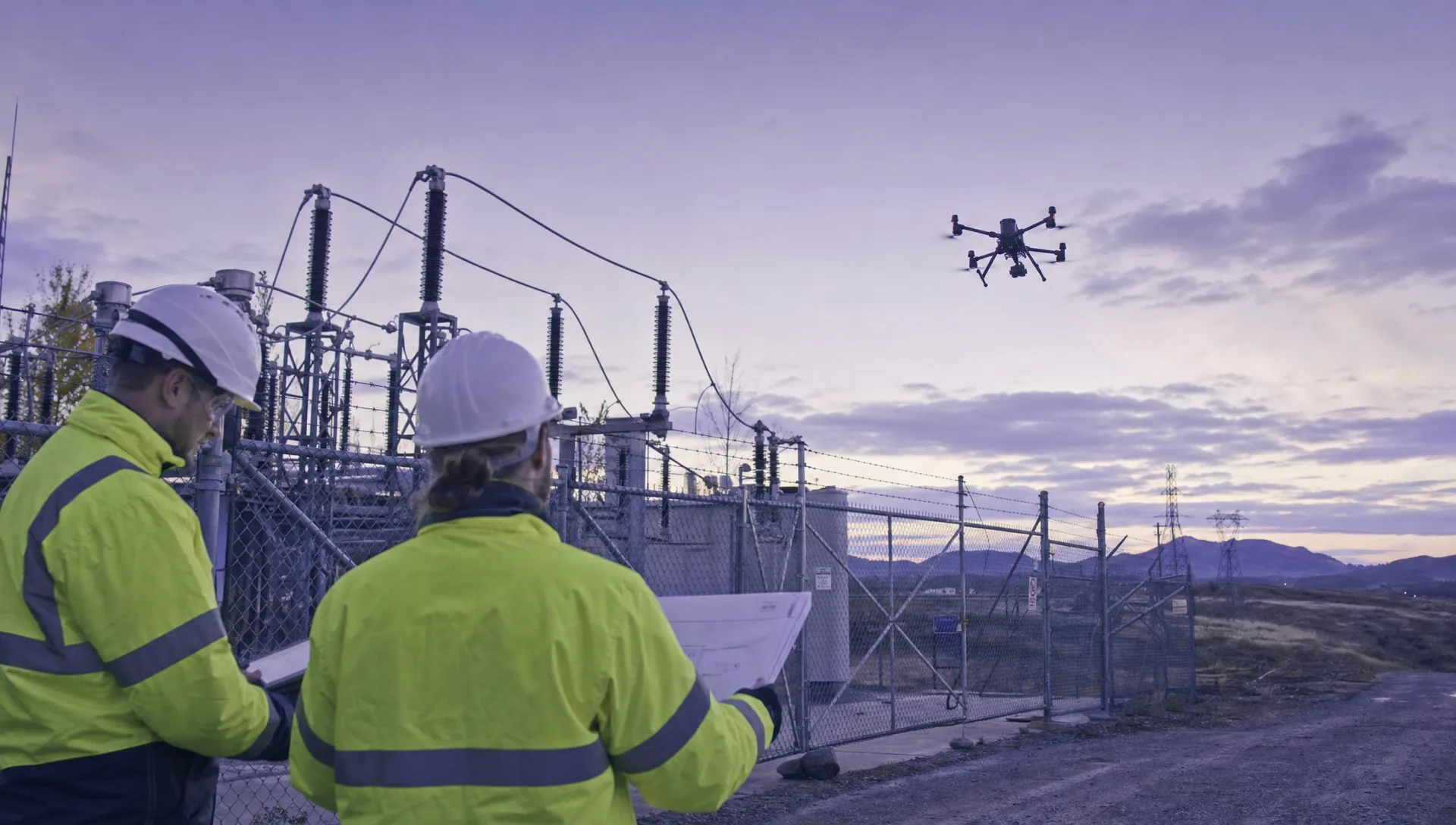
Before checking airspace, define exactly what the critical asset is. A power line inspection may include pylons, substations, access tracks and neighbouring land. A rail inspection may include the track, overhead line equipment, embankments, bridges and station approaches. A water utility site may include treatment processes, reservoirs, outfalls and public rights of way.
The next question is who controls each part of the operating environment. The landowner, asset operator, tenant, facilities contractor, local authority and airspace authority may all be different organisations. Permission from one party does not automatically solve the others.
For commercial work, record at least the asset owner contact, land access permission, site induction requirements, flight area boundaries, security restrictions, escort requirements and any times when flying is prohibited. If the client wants drone data of sensitive areas, clarify who can view, store and share that material before take-off rather than after delivery.
Check the regulatory baseline before planning the mission
Regulations vary by jurisdiction, aircraft class, operating category and mission profile. Do not rely on old templates, cached airspace screenshots or general assumptions about infrastructure sites. Use official sources every time the job is planned, and re-check them close to the operating date.
These drone flying guidelines are not a substitute for current legal advice or regulator guidance. They are a planning framework for professional teams, to be used alongside the rules that apply where the aircraft will fly.
| Region | Official source to check | Why it matters near critical assets |
|---|---|---|
| United Kingdom | Civil Aviation Authority drone guidance | Confirms UK drone rules, registration duties, airspace restrictions and authorisation requirements. |
| European Union | EASA drone regulatory overview | Explains the Open, Specific and Certified framework used across EASA member states. |
| United States | FAA Part 107 small UAS regulations | Sets out the baseline federal rules for many commercial small UAS operations in the US. |
For higher-risk operations, review whether the mission falls into a category requiring an operational authorisation, waiver or equivalent approval. Flights close to people, beyond visual line of sight, near restricted airspace, at night or close to sensitive sites may need additional permissions depending on the jurisdiction.
Build an asset-specific risk assessment
A generic risk assessment is rarely enough for critical asset work. The assessment needs to reflect the asset's real operating conditions, including nearby roads, rail movements, live electrical equipment, confined compounds, security patrols, staff shift changes, wildlife, public access and emergency routes.
Frameworks such as JARUS SORA and the CAA's UK SORA material.htm) are useful because they force operators to think about ground risk, air risk and mitigations in a structured way. Even when a full SORA is not required, the mindset is valuable.
A practical risk assessment turns drone flying guidelines into evidence. It should explain the operating volume, contingency areas, emergency actions, crew roles, communications plan, weather limits, lost link behaviour, geofencing settings where used and the minimum conditions required to start or continue the flight. For more detail on structuring this document, Dronedesk has a separate guide on how to build a drone flight risk assessment that works.
Plan the site, airspace and standoff controls
Good drone flying guidelines should define where the aircraft is allowed to be, not only where it is forbidden to go. Draw the flight geography, contingency area and any keep-out zones on a current map. Include the asset boundary, take-off and landing point, pilot position, observer positions, access routes, emergency landing options and nearby hazards.
Avoid fixed standoff distances copied from unrelated jobs. The right separation from a pylon, mast, crane, railway, chemical tank or substation depends on the aircraft, wind, pilot workload, sensor payload, fail-safe behaviour, local rules and client requirements. If the site operator has minimum distances, treat them as mandatory and document them in the brief.
| Planning layer | Questions to answer before arrival |
|---|---|
| Airspace | Is the site inside controlled, restricted, prohibited or temporary restricted airspace? Are there nearby aerodromes, heliports or emergency aircraft routes? |
| Ground environment | Who can enter the area, how will access be controlled and what happens if the public approach the crew? |
| Asset hazards | Are there live conductors, RF sources, cranes, moving vehicles, rotating plant, steam, flare stacks, water hazards or unstable structures? |
| Navigation reliability | Could metalwork, terrain, structures or interference affect GNSS, compass performance or command and control links? |
| Emergency options | Where can the drone land safely if the mission is aborted, and who must be notified immediately? |
| Data sensitivity | Are there areas that must not be filmed, mapped, uploaded to the cloud or shared outside the approved project team? |
For repeat asset inspections, use the first operation to refine the plan rather than starting from scratch each time. Update the site pack when the asset changes, when access routes move or when new hazards appear.
Control security, privacy and data handling
Critical asset work often produces imagery that is more sensitive than a standard survey. A high-resolution orthomosaic, thermal inspection or video pass can reveal security fencing, CCTV placement, access gates, control rooms, compound layouts or weaknesses that should not be widely distributed.
Agree data rules before the mission. Decide whether geotagged imagery is allowed, where files will be stored, whether removable media must be encrypted, who approves external sharing and how long raw data should be retained. If people, homes, vehicle registrations or staff movements may be captured, apply the privacy and data protection duties that apply in the country of operation.
Cybersecurity also matters. Keep aircraft firmware, controller devices and mission planning tools managed under your organisation's policy. Avoid using unapproved accounts, public Wi-Fi or personal storage for client data. For sensitive clients, confirm whether livestreaming, cloud synchronisation or third-party processing is permitted.
Run the operation with clear crew discipline
On the day, drone flying guidelines only work if the crew applies them under pressure. Start with a site briefing that covers the flight objective, no-fly areas, communications, stop-work authority, emergency contacts, weather limits and what to do if security staff, workers or members of the public approach.
The remote pilot should not be expected to manage every site interaction while flying. Use observers, a site liaison or a client escort where needed. If the asset is live, such as an energised substation, operational railway or active port, the crew must understand who has authority to pause the flight and who can confirm that site conditions remain safe.
Keep the flight plan conservative. Avoid unnecessary overflight of sensitive equipment, workers, public roads or neighbouring properties. If conditions change, stop and re-plan rather than pushing through because the crew is already on site.
| Phase | Control to apply |
|---|---|
| Pre-start | Confirm permissions, weather, airspace status, aircraft condition, battery health, crew roles and emergency contacts. |
| Take-off | Use a secure launch point with clear separation from people, vehicles, loose material and site traffic. |
| In flight | Maintain situational awareness, monitor telemetry, stay inside the planned operating area and keep communications concise. |
| Abort | Land or move to the contingency plan if weather, aircraft behaviour, people, airspace activity or site conditions become unsafe. |
| Close-out | Confirm aircraft status, account for batteries and media, secure data and brief the client on any issues. |
Adapt controls to the asset type
For utility and survey teams, drone flying guidelines should change with the asset rather than relying on one company-wide rulebook. The common principles stay the same, but the hazards around a transmission tower are not the same as those around a rail bridge, reservoir or data centre.
Electrical utilities need careful separation from live equipment, awareness of electromagnetic environments and coordination with site access rules. Rail environments demand strict attention to line safety, overhead wires, moving trains and possession or access arrangements. Telecoms towers can involve guy wires, RF exposure zones and tower climbers working at height. Ports and industrial sites add moving cranes, vessels, hazardous materials and rapidly changing vehicle routes.
Emergency services have a different set of priorities. A drone that helps with incident awareness can also conflict with air ambulances, police aviation, temporary restrictions or other responding aircraft if it is not coordinated. When operating for or near emergency services, the command structure and airspace coordination process should be agreed before the aircraft is launched.
Infrastructure operators with large asset portfolios often need a repeatable planning process rather than one-off paperwork. Dronedesk's utility company case study gives an example of how National Grid uses the platform to support drone flight planning for utility infrastructure inspections.
Log the flight and review what happened
Post-flight review is part of the safety system, not just an admin task. Your drone flying guidelines should define how flight logs, crew notes, incidents, near misses, client feedback and maintenance observations are captured after critical asset work.
Flight records help prove what was flown, when it was flown and whether the aircraft stayed within the plan. They also reveal patterns that are easy to miss in the field, such as repeated GNSS warnings near a structure, battery performance issues, unstable hover behaviour, excessive pilot workload or recurring communication gaps.
If you operate DJI aircraft and need to inspect flight data, Dronedesk provides a DJI flight log analysis tool that can help review logs after a mission. Use the review to update future risk assessments, site packs, maintenance actions and client briefings.
Make critical asset work repeatable with the right system
Spreadsheets and shared folders can work for a small number of simple jobs, but critical asset operations become harder to control as teams, aircraft, clients and recurring sites increase. The weakness is rarely one missing document. It is usually the gap between client records, aircraft records, pilot competence, airspace checks, risk assessments, checklists, approvals, logs and reports.
Dronedesk brings client management, fleet management, team management, airspace intelligence, proximity intelligence, flight planning, flight logging, data reporting, configurable checklists and risk assessments into one web platform, as described on the Dronedesk features page. For operators working around sensitive infrastructure, that helps keep the planning trail, operating controls and post-flight records in one place.
Frequently Asked Questions
Do I always need the asset owner's permission to fly near a critical asset? If the work involves access to land, site staff, security procedures, close inspection or client deliverables, you should obtain clear permission from the relevant asset owner or operator. Airspace legality and site permission are separate issues.
Are drone flying guidelines different near critical infrastructure? Yes. The aircraft may be the same, but the consequences of an error are higher. Operators should add stronger controls for permissions, standoff distances, site security, data handling, emergency procedures and post-flight review.
Can I fly if my airspace app shows no restriction over the site? Not automatically. An airspace app is only one input. You still need to check official sources, current notices, site rules, land access, privacy duties, client restrictions and whether the mission falls within your authorisation.
What should be in a critical asset flight risk assessment? Include the mission objective, operating area, airspace review, asset hazards, ground risk, aircraft limitations, crew roles, communications, weather limits, emergency actions, security controls and data handling rules.
How often should repeat inspection plans be updated? Review them whenever the asset, access route, surrounding land use, regulation, aircraft, payload, crew or client requirement changes. For recurring work, a short post-flight review after each mission helps keep the plan current.
Plan critical asset missions with less friction
Critical asset flights need more than a capable aircraft. They need a clear approval trail, disciplined site planning, reliable risk assessment, consistent checklists and usable flight records.
If your team is moving from occasional inspections to repeatable infrastructure operations, Dronedesk can help bring the operational admin into one workflow so crews spend less time hunting for information and more time flying safely, compliantly and consistently.
 FAA Rules and Regulations for Drones on Shared Worksites →
 Drone Pilot 107 Refresher Training After a Career Break →
 How to Track Drone Regulations Worldwide as a Business →
 FAA Rules for Flying Drones at Night During Emergency Missions →
 How to Onboard an FAA 107 Pilot for Utility Inspections →
 FAA Drone Rules for Commercial Use on Construction Sites →
 When Should You Retire a Commercial Drone? →
 Drone Fleet Management Software - The Platforms That Failed, and the Ones Still Flying →
 FAA Drone Pilot License: A Manager’s Compliance Checklist →
 Part 107 Classes: How to Choose Training That Fits Your Role →