
Drone Pilot 107 Refresher Training After a Career Break
Returning to commercial flying after a career break takes more than charging batteries and finding your old certificate. A drone pilot 107 refresher should address three separate questions: are you eligible to operate, can you still handle the aircraft confidently and can you manage a real job without overlooking something important?
Those questions need different checks. Online recurrent training addresses aeronautical knowledge recency, but it does not demonstrate aircraft-handling proficiency or familiarity with your employer’s procedures. This guide focuses on returning to US FAA Part 107 operations, with a practical progression from checking your status to completing a supervised mission rehearsal.
Check your certificate and aeronautical knowledge recency
Your Remote Pilot Certificate and your aeronautical knowledge recency are not the same thing. The certificate does not expire, but the FAA requires you to maintain aeronautical knowledge recency to exercise its privileges.
The FAA’s guidance for remote pilots explains the requirement to complete the applicable recurrent training within the previous 24 calendar months. It also distinguishes training routes according to your existing pilot qualifications. Use that guidance to select the correct course rather than relying on an old training provider’s email.
If you already hold a certificate, a career break does not automatically mean repeating the initial knowledge examination. Start with the FAA’s existing-certificate-holder pathway. If you never completed certification, you need the initial pathway instead.
For your drone pilot 107 refresher, assemble a small evidence pack containing your certificate, relevant training completion records and any employer-required competency records. Check the dates and identify what needs updating before scheduling operational work.
Keep regulatory eligibility separate from company approval. A survey business, utility contractor or emergency-service organisation may have its own requirements for aircraft familiarisation, supervised flights or task authorisation. Completing an FAA course does not replace those checks.
Revisit operating rules before relying on old habits
A returning pilot’s biggest knowledge gap may be an assumption that used to feel routine. Revisit the FAA’s Part 107 overview, then check the requirements that apply to your intended aircraft, location and operation.
Use this review to answer specific operational questions:
| Topic | Question to resolve before flying |
|---|---|
| Aircraft registration | Are the registration details and aircraft markings appropriate and current? |
| Remote ID | What compliance route applies to this aircraft and planned operation? |
| Airspace | Does the location require authorisation, and have you checked its conditions? |
| Night operations | What pilot, aircraft and operational requirements apply? |
| Operations over people | Does the proposed flight meet the applicable requirements, or must the plan change? |
| Existing approvals | Do any waivers or authorisations actually cover this mission and remain valid? |
For aircraft identification, work through the FAA’s Remote ID guidance. Do not assume that an older aircraft’s registration resolves every identification requirement.
Review the FAA’s operations over people and at night guidance before accepting either type of assignment. Holding a certificate alone does not establish that a particular flight is permitted.
Your drone pilot 107 refresher should also include an airspace-planning exercise. Where relevant, revisit LAANC and its authorisation process, then distinguish airspace permission from site access, landowner permission and the practical safety of the flight.
Build a drone pilot 107 refresher around an actual job
Choose a representative assignment, not an unusually easy demonstration flight. A survey operator might use a small mapping site. A utility pilot could rehearse an inspection without approaching live infrastructure. An emergency-service team could practise a planned search exercise away from an active incident.
Build the job from the beginning: define the required output, inspect the proposed operating area and identify what would make you decline or postpone it. Review current chart information and relevant weather reports. Explain what the forecast means for this aircraft and location rather than simply recording a wind figure.
Pay particular attention to changes in the site. A familiar location may now have construction cranes, new access routes, different public activity or vegetation that blocks your previous landing area.
Use a structured flight risk assessment to connect each significant hazard with a control you can actually implement. “Monitor pedestrians” is weak unless someone has responsibility, a clear view and a defined response when the boundary is approached.
Finish the planning exercise with a short crew briefing. Another person should be able to explain the operating boundary, their role and the conditions that would stop the flight.
Re-familiarise yourself with the aircraft before testing your flying
An aircraft you once knew well can behave differently after equipment changes, software updates or a long period in storage. Treat it as a fresh familiarisation task rather than relying on muscle memory.
Inspect the airframe, propellers, motors, controller and charging equipment against the manufacturer’s instructions. Examine batteries for damage, swelling, storage-related deterioration and abnormal behaviour. Do not use a questionable battery simply to complete a practice session.
Review software and firmware compatibility, then check the actual configuration: control mode, units, obstacle-sensing behaviour, lost-link action and return-to-home settings. Avoid making an untested update immediately before a client assignment.
The equipment stage of your drone pilot 107 refresher should end with you explaining what the aircraft will do after a lost connection. Check the configured behaviour against nearby obstacles, the selected home point and the manufacturer’s instructions. A remembered default is not evidence of the current setting.
Rebuild handling skills in a controlled environment
Choose a suitable practice location and begin with short, deliberate exercises. The following progression is a suggested proficiency check, not an FAA-mandated syllabus.
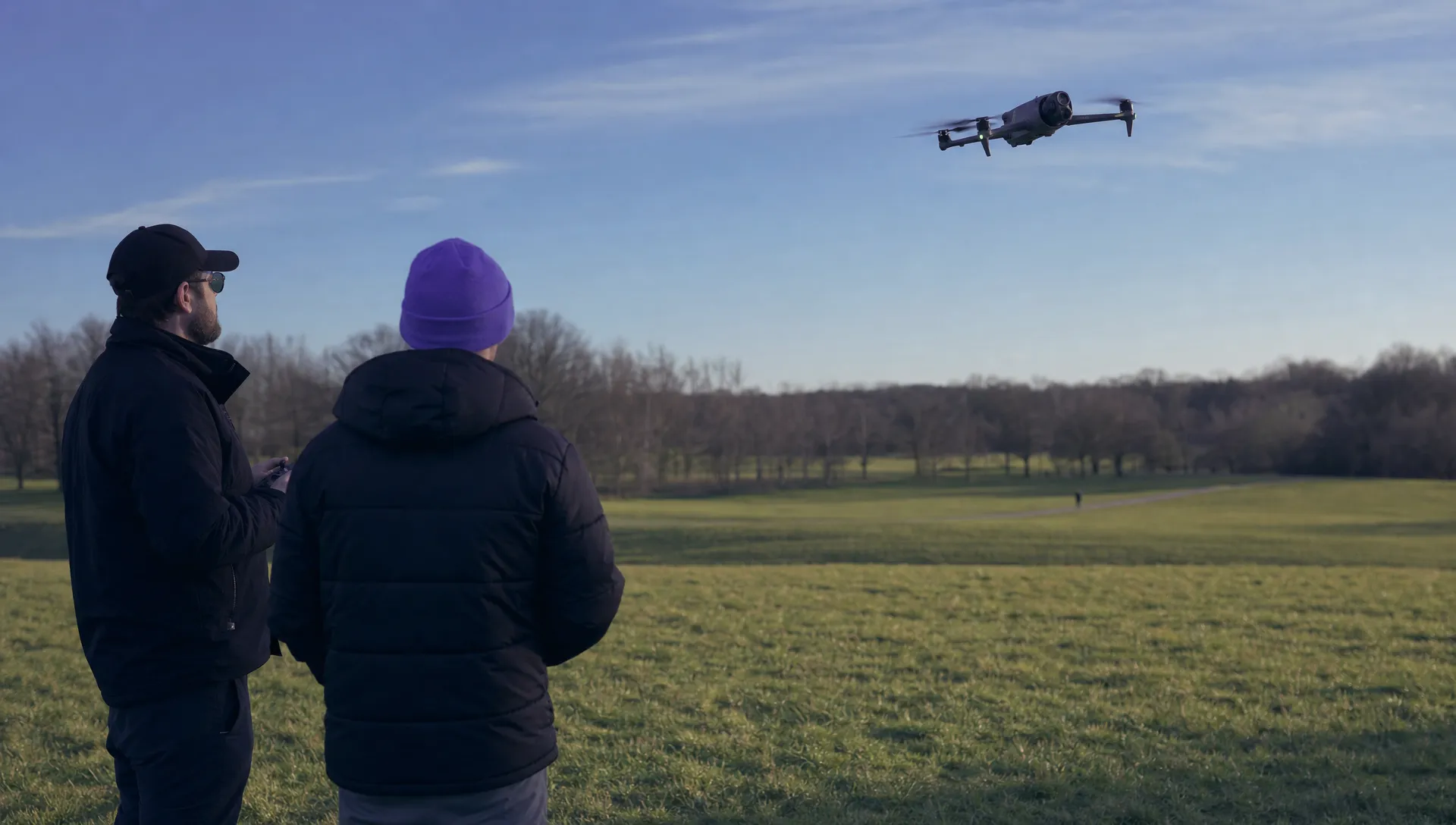
- Basic handling: Practise stable hovering, controlled movement, orientation changes and accurate landings within a defined area.
- Task transitions: Move between a simple flight task, position checks and battery monitoring without becoming absorbed in the screen.
- Recovery decisions: Rehearse an early landing, a rejected task and a change to the planned landing area when conditions allow safe practice.
Ask an experienced colleague or instructor to observe if your confidence, coordination or situational awareness has deteriorated. Their job is to spot missed checks and delayed decisions, not merely confirm that the aircraft stayed airborne.
Rehearse abnormal situations without creating an emergency
Emergency procedures are easy to recognise in a quiz and harder to execute during a distracting job. Practise decision-making through tabletop scenarios before adding complexity in flight.
Have a colleague introduce a realistic change: a pedestrian enters the operating area, the observer loses their useful view or the planned landing zone becomes unavailable. State what you would do, who needs to know and whether the mission can continue.
Then rehearse only the elements that can be practised safely. Do not deliberately exhaust a battery, disable essential safeguards or create a lost-link event simply to demonstrate confidence. Follow manufacturer procedures and use simulation or ground discussion where an airborne exercise would add unnecessary risk.
A useful drone pilot 107 refresher tests whether you recognise a stopping point early enough. For inspection and survey work, that may mean accepting incomplete coverage rather than stretching the flight to finish one more pass.
Crew communication deserves equal attention. Agree plain-language calls for an approaching person, aircraft traffic, loss of visual contact and an immediate landing. Confirm who makes each call and how the remote pilot acknowledges it. Avoid assuming that colleagues remember the same procedure you do.
Use flight records to check performance, not just activity
Flight time alone is a poor return-to-work measure. Ten repetitive flights may reveal less than one carefully observed exercise followed by an honest debrief.
Record what you practised, the conditions, the aircraft configuration and any intervention or unexpected behaviour. Where flight logs are available, compare the recorded sequence with your recollection of the flight. For DJI aircraft, the Dronedesk DJI flight log analysis tool provides a dedicated starting point for log review.
Keep analysis proportionate. Logs can help investigate what happened, but they cannot establish that your crew briefing was clear or that your assessment of public activity was sound. Combine them with observation and notes.
Use your drone pilot 107 refresher records to answer practical questions: did you notice the developing problem, make the right decision and communicate it promptly? Record the corrective action and repeat the relevant exercise if the answer is no.
A useful debrief identifies one or two specific improvements. “Be more careful” is not actionable. “Move the observer so they can see the site entrance before take-off” is.
Set clear return-to-work gates
Decide your readiness criteria before commercial pressure enters the conversation. Otherwise, an approaching deadline can turn an unresolved weakness into an acceptable risk.
These suggested gates separate paperwork completion from operational performance:
| Readiness area | Evidence to look for | Reason to pause |
|---|---|---|
| Eligibility | Relevant certificate, knowledge recency and required approvals checked | Missing evidence or unresolved applicability |
| Aircraft readiness | Inspection completed and configuration understood | Battery concerns, faults or unfamiliar behaviour |
| Planning | Site, weather, airspace and ground risks explained | Important assumptions remain unverified |
| Practical handling | Consistent control and landings without coaching | Repeated orientation errors or delayed responses |
| Crew coordination | Briefing and abnormal-situation calls demonstrated | Unclear responsibilities or missed communications |
| Mission delivery | Rehearsal completed without stretching safety margins | Task pressure overrides the agreed limits |
These are operational recommendations, not additional FAA certification requirements. Adapt them to your aircraft, task complexity and organisation’s procedures.
For a first assignment back, reduce complexity where possible. Choose familiar equipment, manageable conditions and enough time for a proper briefing. Avoid combining a new aircraft, unfamiliar site and demanding client deadline on the same day.
The final drone pilot 107 refresher decision should be based on demonstrated performance, not how experienced you were before the break. If a weakness remains, assign another practice session or obtain instruction before accepting the task.
Frequently asked questions
Do I need to retake the initial Part 107 test after a career break? Not automatically. Existing certificate holders should follow the FAA’s guidance on maintaining aeronautical knowledge recency and select the applicable recurrent-training route. Someone who never obtained a Remote Pilot Certificate needs to follow the initial certification process.
Is online recurrent training enough to return to commercial flying? It addresses the relevant knowledge-recency requirement, but it does not demonstrate aircraft-handling proficiency, current equipment knowledge or readiness for a particular assignment. Add practical familiarisation and any checks required by your organisation.
How many practice flights should I complete? There is no single recommendation that suits every returning pilot. Base your plan on the length of the break, equipment changes, task complexity and observed performance. Repeat exercises until the required skills are reliable rather than aiming for an arbitrary flight count.
Can I return straight to inspection or emergency-service work? Assess the specific role and operating arrangements first. Specialist tasks can involve additional hazards, procedures and organisational approvals. Start with a controlled rehearsal and resolve gaps before accepting an operational assignment.
Put your return-to-flight process in one place
Keep your training evidence, aircraft checks, practice debriefs and first-job plan together so that you or a supervisor can review readiness without reconstructing it from scattered messages.
As you organise that workflow, compare Dronedesk’s published features with your planning, checklist, risk-assessment and record-keeping requirements. Start with the process you need to demonstrate, then choose the tools that support it.
 Drone Pilot 107 Refresher Training After a Career Break →
 How to Track Drone Regulations Worldwide as a Business →
 FAA Rules for Flying Drones at Night During Emergency Missions →
 How to Onboard an FAA 107 Pilot for Utility Inspections →
 FAA Drone Rules for Commercial Use on Construction Sites →
 When Should You Retire a Commercial Drone? →
 Drone Fleet Management Software - The Platforms That Failed, and the Ones Still Flying →
 FAA Drone Pilot License: A Manager’s Compliance Checklist →
 Part 107 Classes: How to Choose Training That Fits Your Role →
 Drones for Commercial Use: How to Match Aircraft to Risk →