
How to Build a Drone Business Operations Manual
A drone business operations manual should explain how your team accepts work, prepares flights, manages changing conditions and closes out each job. It needs to be usable by the person making decisions on site, not just readable by the person who wrote it.
The strongest manuals connect three things: a clear operating standard, a practical procedure and a record showing what happened. If those connections are missing, a polished document can still leave pilots guessing about responsibilities, equipment readiness or when to stop.
This guide provides an internal operating-document framework, including a contents template, a worked procedure and a rollout process. It is not a determination of the authorisations your proposed work needs. Build the manual around your actual aircraft, services and operating environment, then check its requirements against the sources relevant to your operation.
What a drone business operations manual should contain
Start with a short core document and supporting procedures. Keep frequently changing information, such as aircraft inventories and contact details, in controlled registers rather than repeating it throughout the manual.
| Section | Questions it should answer | Supporting record or document |
|---|---|---|
| Scope and document control | What work does this cover, who owns it and which version applies? | Revision history and distribution register |
| Roles and responsibilities | Who accepts jobs, prepares plans and makes flight decisions? | Responsibility matrix and competence records |
| Job acceptance and planning | Is the proposed work suitable, and what preparation is needed? | Job brief, site assessment and risk assessment |
| Aircraft and equipment | How is equipment selected, checked and released for use? | Equipment register and maintenance records |
| Flight execution | What happens before, during and after flight? | Operational checklists and flight records |
| Abnormal events | What actions follow a fault, incident or unexpected site change? | Response procedures and event report |
| Data and delivery | How are outputs checked, protected and handed over? | Quality checks and delivery record |
| Review and improvement | How are problems identified and procedures updated? | Review log and corrective actions |
Your drone business operations manual should distinguish between policy and procedure. “Aircraft must be serviceable before deployment” is a policy; the procedure identifies who checks serviceability, what they inspect and where they record the result.
Appendices can hold equipment-specific instructions, forms and specialist procedures. Reference them by document identifier so a reader can find the correct version without searching through folders.
Set the scope and control the document
Describe the services and environments the manual covers. A survey team collecting mapping data has different delivery checks from a utility inspection team or an emergency-services unit supporting a developing incident.
State the boundaries explicitly: operating locations, aircraft types, team arrangements and activities requiring additional review. Identify work outside the manual’s scope rather than leaving staff to infer whether a procedure applies.
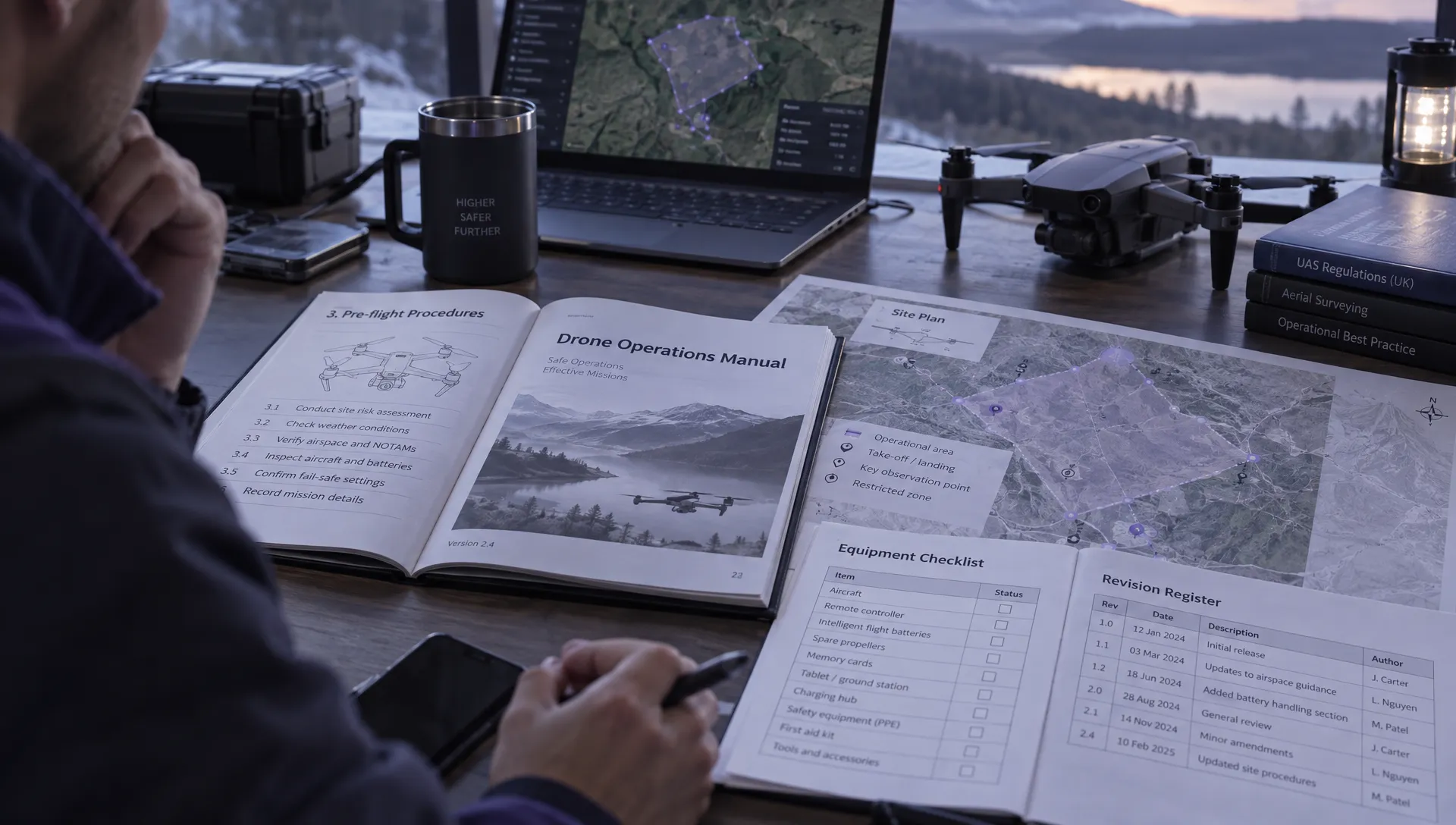
Give the document an owner, approver, version number and effective date. Maintain a revision history that records what changed and why. Specify where the current version is held, how field staff access it and what happens to superseded copies, including downloaded or printed versions.
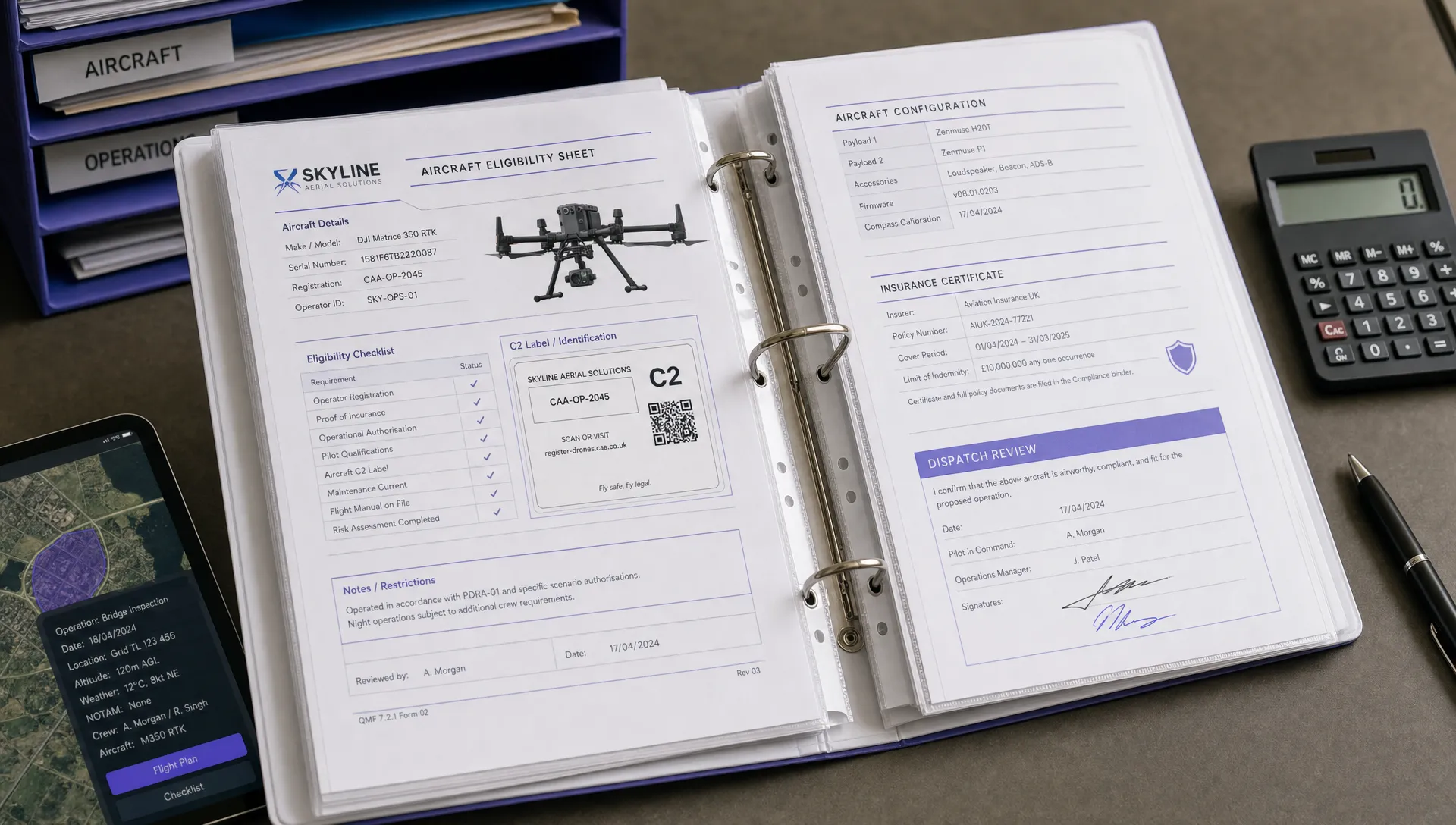
A drone business operations manual also needs a source register. Record each source’s title, issuing organisation, reference or link, date checked and the procedures it affects. For UK work, consult the CAA’s drone guidance when checking current requirements. Use the relevant aviation authority for other jurisdictions rather than carrying assumptions across borders.
Assign responsibility for these checks. An annual review date alone will not capture a significant equipment change, revised operating requirement or incident that reveals a procedural gap.
Allocate responsibilities, including stop-work authority
Use role titles rather than employee names in the procedures. Names can change without forcing you to rewrite the manual.
Define who accepts the job, prepares the flight plan, checks equipment, approves deployment and verifies the deliverable. Separately identify who makes the on-site flight decision and who can stop work when conditions become unsuitable.
For a small operator, one person may hold several roles. Keep the responsibilities distinct even when they belong to the same individual. That makes later delegation easier and exposes tasks that otherwise get overlooked.
Your drone business operations manual should explain how conflicting instructions are resolved. A client’s preferred deadline or a manager’s commercial commitment must not silently override the team’s documented operating limits.
Include competence expectations for each task, the evidence used to assess readiness and the process for supervising someone learning a new role. Avoid treating general flying experience as proof of competence for every aircraft, payload or specialist assignment.
For multi-aircraft teams, connect equipment responsibilities with your drone fleet management practices, particularly defect reporting, maintenance ownership and release back into service.
Write procedures around the job lifecycle
Follow the order in which work happens: enquiry, acceptance, planning, deployment, flight, close-out and delivery. This helps staff locate the right instruction when they need it.
Job acceptance and preparation
The acceptance procedure should capture the intended outcome, location, proposed timing and relevant site contacts. It should also identify constraints that could make the task unsuitable or require further assessment before a commitment is made.
During planning, describe how the team checks the operating environment, site access, people nearby, weather, equipment suitability and applicable restrictions. Require unresolved issues to be escalated rather than hidden in free-text notes.
Keep the method for building a practical flight risk assessment connected to the job plan. Each control needs an owner and a way to confirm it is in place.
Deployment, flight and close-out
Turn the planning outputs into field checks. A control identified at a desk must still be checked against conditions on arrival.
A drone business operations manual should make this handover explicit: what the crew must confirm, which changes require reassessment and where the decision to proceed is recorded.
For flight execution, cover briefings, equipment checks, communication, monitoring and responses to changing conditions. For close-out, cover aircraft inspection, defect recording, log completion, data handling and site handback.
Do not mix safety checks with deliverable acceptance. A flight can end without incident while the collected data still fails the client’s specification. Both outcomes need separate checks.
Use a consistent standard operating procedure template
Every standard operating procedure (SOP) should identify its purpose, trigger, responsible role, actions, stop conditions and required evidence. A checklist then supports execution of that procedure; it should not carry all the explanation itself.
Here is a worked example to adapt and validate against your own operation.
Example SOP: site arrival and release to fly
Purpose: Confirm that actual site conditions remain compatible with the prepared job plan before flight begins.
Trigger: Arrival at a new site or a material change in conditions during the assignment.
Responsible role: The designated flight lead, with input from other crew members and the site contact where relevant.
| Action | Decision or evidence |
|---|---|
| Confirm the task and operating area | Record any difference from the accepted job brief |
| Inspect launch, recovery and contingency locations | Confirm suitability or select alternatives for assessment |
| Check people, access routes, obstacles and nearby activity | Update the site assessment and controls where needed |
| Check weather and equipment readiness | Compare observations with documented operating limits |
| Brief the crew on roles, communications and stop conditions | Confirm understanding and resolve uncertainties |
| Decide whether to proceed, revise or postpone | Record the decision and any revised controls |
Stop conditions: Pause when a required control cannot be established, an equipment defect remains unresolved or conditions fall outside the documented limits. Explain who must be consulted before restarting.
Required record: A completed site check, any revised assessment and the decision-maker’s identity.
This gives your drone business operations manual an observable standard. A reviewer can establish whether the procedure was followed, rather than relying on a vague instruction to “check the site”.
Define the records that prove procedures were followed
For each procedure, specify the record produced, its owner and where it is stored. Link records through a common job reference so someone reviewing an assignment can reconstruct it without matching unrelated filenames.
Useful records include the accepted brief, planning decisions, risk controls, equipment checks, crew allocation, flight log, defects and delivery checks. Record changes made on site as well as the original plan.
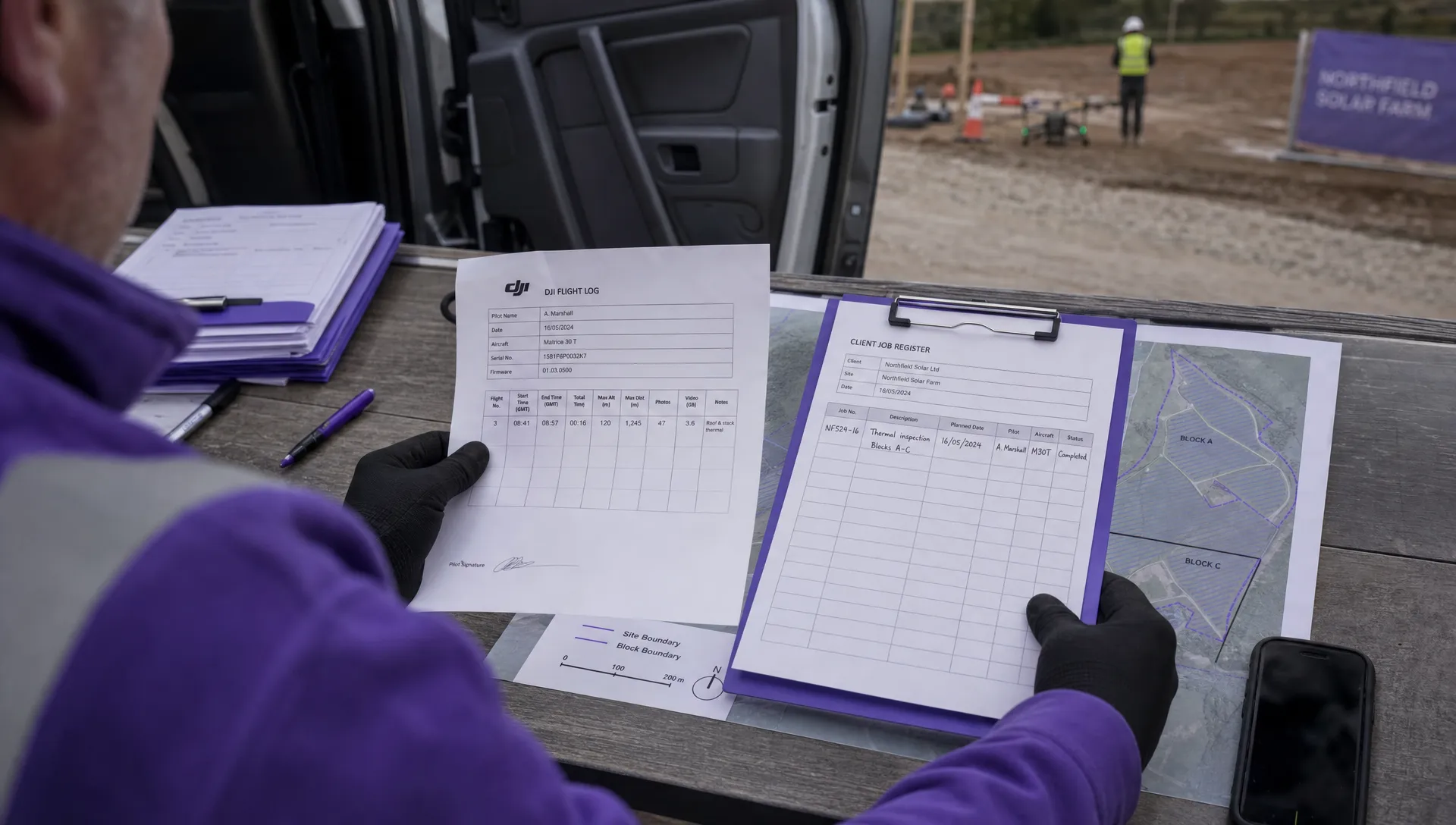
For flight logs, define the fields your team needs for operational review, such as aircraft identity, operator, date, flight duration, purpose and relevant observations. If DJI log review forms part of your process, reference the DJI flight log analysis tool in the procedure. Distinguish technical flight data from the operational record explaining decisions and events.
Your drone business operations manual should also define record access, backup arrangements and retention decisions. Check those decisions against applicable requirements, contracts and your organisation’s information policies rather than adopting an arbitrary retention period.
For survey work, specify how outputs are checked against the agreed data specification. For utility inspections, define asset identification and reporting checks. For emergency-services work, document how information is handed over and how decisions are recorded when the situation develops quickly.
Test the manual before issuing it
A desk review catches missing sections. A practical walkthrough catches instructions that cannot be followed.
Choose a representative assignment and ask someone other than the author to work through the manual. Have them locate the applicable procedure, prepare the required records and explain what they would do if conditions changed.
Test at least one abnormal scenario, such as a newly reported aircraft defect, loss of the planned launch area or unexpected activity near the operating site. Check whether the document identifies the decision-maker and the conditions for stopping or restarting.
A drone business operations manual is ready for release when users can follow it without relying on undocumented knowledge. If the author has to keep explaining what a sentence means, revise the sentence or add the missing instruction.
After testing, record the issues, assign corrective actions and approve the revised version. Brief affected staff on changes and capture acknowledgement or training evidence appropriate to the change.
Review the manual after incidents, near misses, new aircraft, new services and significant procedural changes. Also schedule periodic reviews so quiet periods do not leave the document untouched indefinitely.
Useful internal measures include incomplete records, recurring defects, unresolved review actions and repeated deviations from procedure. Use them to find weak processes, not simply to count completed forms.
Frequently asked questions
How long should an operations manual be? Long enough to define your operating standards and procedures, but short enough for users to navigate. There is no useful universal page target. Keep stable policy in the core document and place detailed equipment instructions, forms and specialist procedures in controlled supporting documents.
Can a sole operator use a shorter manual? Yes. A drone business operations manual can be proportionate to a one-person operation. You still need clear decision points, equipment checks, abnormal-event procedures and records. Combining roles reduces the organisational detail, not the need to explain how work is performed.
Should every aircraft have a separate manual? You can use one core manual with aircraft-specific procedures where that arrangement fits your operation. Keep differences in limitations, checks, maintenance and abnormal-event responses explicit. Avoid a generic instruction that could be interpreted differently for different aircraft.
How often should it be updated? Set a scheduled review interval and identify events that trigger an earlier review. Those triggers should include changes to equipment, services, operating requirements and lessons from incidents or practical use. Record each review even if no amendment is needed.
Make the manual usable in daily operations
Once your procedures are clear, compare your working requirements with Dronedesk’s published features. Check how you will keep job information, operational records and procedure references connected before choosing your setup.
Start with one representative job, test the complete workflow and fix the gaps before extending it across the team. The manual sets the standard; your everyday working system should make that standard straightforward to follow.
 Drone Regulations for Commercial Use With Mixed Aircraft Fleets →
 FAA 107 Test Study Plans for Shift Workers →
 How to Match a DJI Flight Log to a Client Job →
 Drone Regulations Under 250 Grams for Mixed-Weight Fleets →
 Drone Safety Guidelines for Working Near Water →
 FAA Rules and Regulations for Drones on Shared Worksites →
 Drone Pilot 107 Refresher Training After a Career Break →
 How to Track Drone Regulations Worldwide as a Business →
 FAA Rules for Flying Drones at Night During Emergency Missions →
 How to Onboard an FAA 107 Pilot for Utility Inspections →