
How to Onboard an FAA 107 Pilot for Utility Inspections
Onboarding an FAA 107 pilot for utility inspections involves more than checking a certificate and assigning a drone. The pilot must understand the assets, recognise site-specific hazards and produce inspection data that engineers can actually use. A competent aerial photographer may still need substantial preparation before inspecting overhead lines, substations or generation facilities.
The most useful approach is a staged onboarding process: verify credentials, define operating boundaries, teach asset-specific procedures, assess supervised performance and authorise a clearly limited scope of work.
The training gates below are suggested company controls, not universal legal requirements. Confirm the rules applicable to each mission through current FAA sources and follow the utility's own safety procedures.
Define the assignment before choosing the training
Start with the work the pilot will perform, rather than a generic drone induction. Inspecting a transmission tower requires different positioning, asset knowledge and image coverage from documenting a solar installation.
Create a role profile that identifies the asset types, aircraft, sensors, inspection methods and expected deliverables. Include who commissions the work, who controls site access and who accepts the finished inspection package.
An FAA 107 pilot should leave this discussion knowing both what they are authorised by the company to do and what remains outside their assigned scope.
Separate three responsibilities that are often blurred together:
- Flight decisions: Who makes the go/no-go decision, manages the aircraft and stops an unsafe operation?
- Site coordination: Who confirms access arrangements, work activity and asset-owner restrictions?
- Inspection interpretation: Who reviews imagery and decides whether an apparent defect warrants engineering action?
One person may hold more than one role, but the responsibilities should remain explicit. Flying the aircraft does not automatically qualify someone to diagnose electrical defects or approve an asset for continued service.
Verify your FAA 107 pilot credentials and mission requirements
Check the person, not just a certificate photograph
Verify the pilot's identity and Remote Pilot Certificate details. Review evidence of the knowledge or training recency applicable to their circumstances against the FAA's remote pilot certification guidance.
Keep the evidence in the personnel record and assign responsibility for reviewing it. Treat company training, aircraft familiarisation and utility experience as separate checks, rather than assuming the certificate establishes all three.
For contractors, request the same operational evidence you would require from an employee. Clarify who supplies the aircraft, maintains it, obtains mission permissions and retains the records. Confirm insurance against the contract and your organisation's requirements without presenting a particular policy limit as an FAA rule.
Review the proposed operation separately
The credentials of an FAA 107 pilot are only one part of the mission review. Check the actual flight against the current Part 107 regulations, including the relevant operating conditions and any permissions needed for the proposed activity.
Include airspace, visual line of sight, proximity to people or traffic and the planned operating times in that review. Check the aircraft's applicable Remote ID arrangements using the FAA's Remote ID guidance.
Do not equate permission to enter a utility site with permission to use the airspace. Equally, an aviation authorisation does not replace the asset owner's access and safety arrangements.
Turn utility hazards into practical operating boundaries
Teach the asset-specific risks
Build the induction with the utility's safety and engineering teams. Cover the hazards relevant to the assignment, such as energised equipment, difficult-to-see conductors, moving machinery, restricted access and nearby work crews.
The objective is not to turn the pilot into an electrical engineer. It is to help them recognise situations that require a different flight plan, specialist advice or a stop-work decision.
An FAA 107 pilot needs asset-specific operating boundaries, not a generic instruction to “keep a safe distance”. Have the appropriate specialists establish those boundaries for the equipment, aircraft and inspection method involved. Do not substitute a single internet-sourced stand-off distance for the utility's procedures.
Make stop-work decisions observable
Translate the risk assessment into decisions the assessor can test. Examples include stopping when an unexpected crew enters the inspection area, when the planned view of the aircraft is obstructed or when positioning becomes unstable.
Teach pilots to consider radio and navigation performance without assuming every industrial site creates the same interference conditions. An unexpected aircraft response calls for the agreed recovery procedure, not an improvised attempt to finish the inspection.
Discuss aircraft recovery too. The pilot should know whom to contact if a drone lands inside a restricted area and should not enter an electrical exclusion zone to retrieve it.
Define what an acceptable inspection looks like
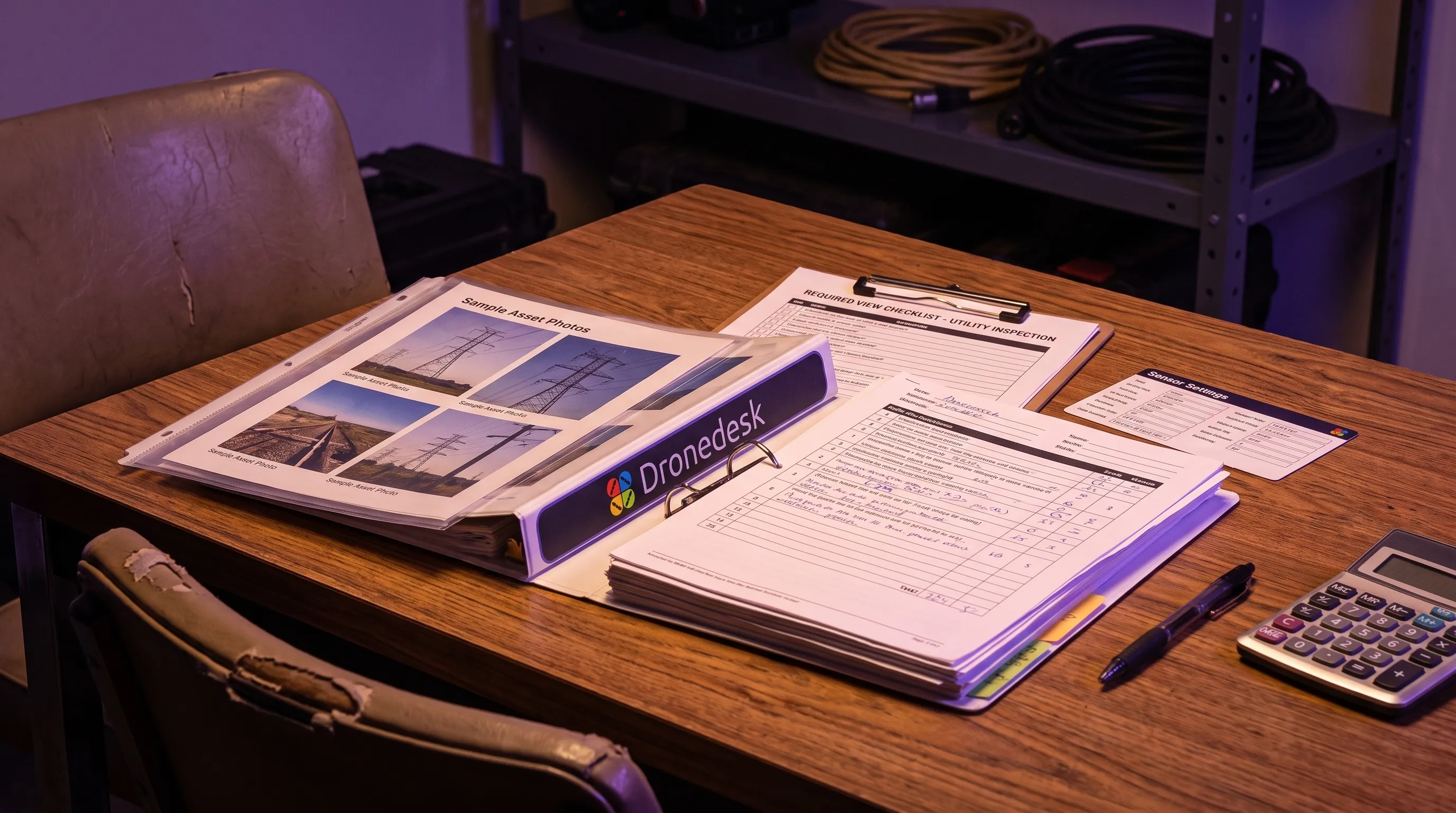
Onboarding fails when pilots learn to collect attractive images but not useful evidence. Give the trainee an example inspection package with the asset identifiers, required views and acceptance criteria clearly marked.
For visual work, specify the components to cover, the required image clarity and the method for identifying location. A sharp photograph of an unknown component can still be unusable.
For thermal work, agree the information the reviewer needs alongside the imagery. Depending on the inspection method, this may include equipment loading, environmental conditions, sensor settings and viewing geometry. Specialist thermography training may be appropriate for the assigned role.
An FAA 107 pilot should understand when an image supports a finding and when it merely flags a component for further investigation. Avoid teaching that a thermal anomaly alone proves a particular defect.
Include an incomplete-data example in the induction. Ask the trainee to identify missing coverage and explain whether another flight would be justified. This tests their understanding of the inspection objective, rather than just their ability to operate the camera.
Establish one mission-planning and evidence workflow
Give the pilot a consistent route from work request to completed inspection. A practical sequence is to confirm scope, identify hazards, review mission requirements, allocate personnel and equipment, prepare the flight plan and brief the team.
Use a completed example to show how those decisions are recorded. The trainee should be able to distinguish the asset owner's permission, aviation permissions, the risk assessment and the crew briefing instead of treating them as interchangeable documents.
For guidance on connecting hazards to usable controls, incorporate the approach in building a drone flight risk assessment into your company template.
An FAA 107 pilot should also learn where to record a changed plan, an aborted flight or a deviation from the original inspection scope. Those events can be valuable evidence of good judgement.
If your team uses Dronedesk, its features page covers client, fleet and team management alongside flight planning, configurable checklists, risk assessments and flight logging. Map the relevant functions to your own process. Software should support the workflow, not be treated as proof that a flight is compliant or a pilot is competent.
Use supervised exercises before live utility assignments
Begin in a representative training environment
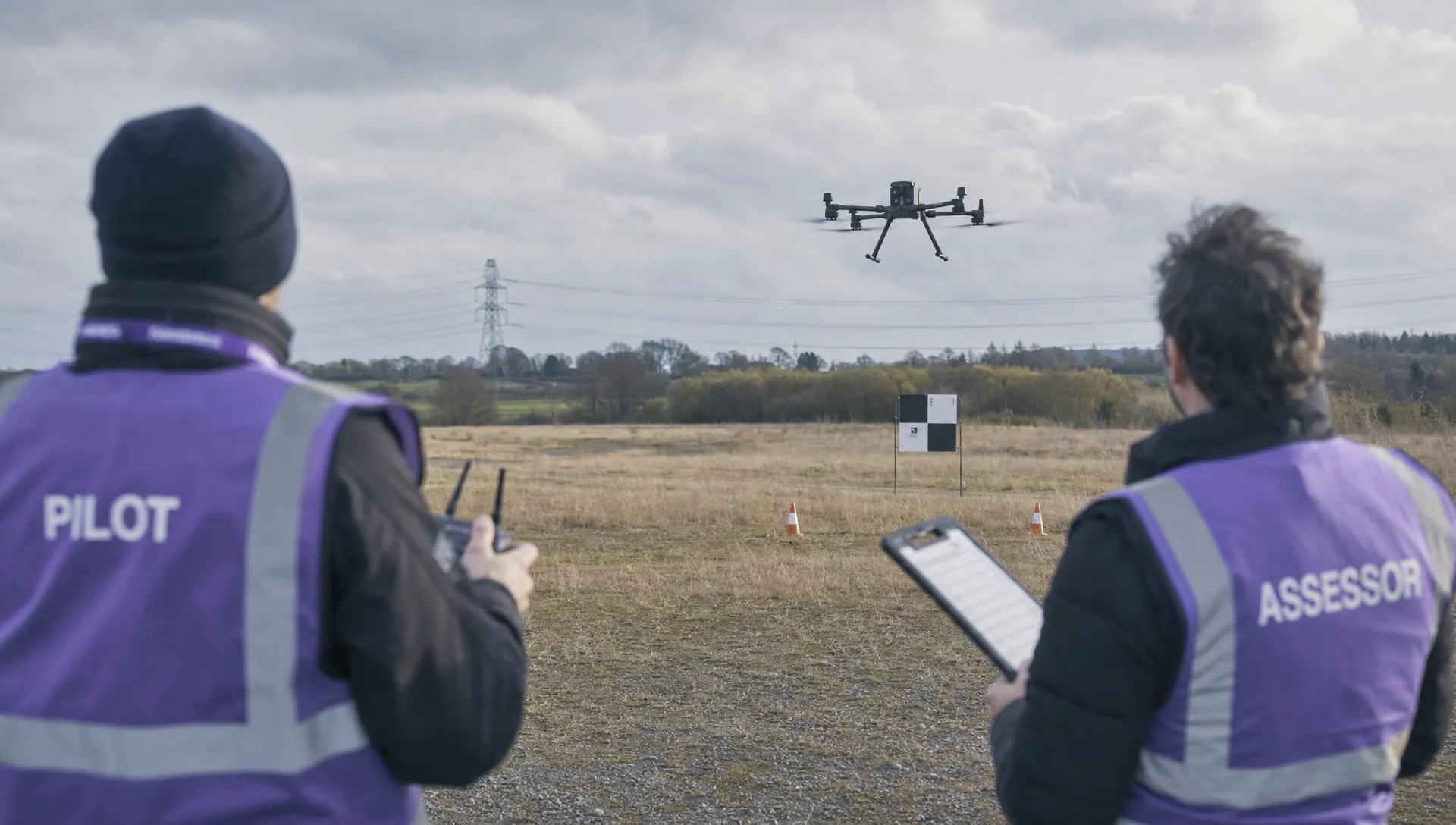
Start aircraft familiarisation away from live utility hazards. Use a suitable training area and a mock inspection target to practise positioning, camera control, crew communication and collection of the required views.
This stage should reveal whether the trainee can manage the aircraft while maintaining awareness of the wider operation. It also lets you distinguish piloting difficulties from gaps in asset knowledge.
Before supervising an FAA 107 pilot on a utility assignment, agree who will make operational decisions and how an intervention will be communicated. Avoid ambiguous arrangements in which two people both believe the other is responsible for stopping the flight.
Practise abnormal situations without deliberately creating an uncontrolled aircraft event. Tabletop exercises, simulator work where available and safely staged scenarios can test decisions about deteriorating weather, unexpected site activity or an unavailable landing area.
Progress to a controlled site assessment
Move to a live site only when the earlier training supports it and the mission review permits the exercise. Select a manageable assignment with clear inspection objectives and an experienced assessor.
Observe the whole job, including arrival, access checks, briefing, flight preparation, data review and close-out. Do not assess competence solely through the airborne portion.
The assessor should intervene when necessary, record why and distinguish a coaching flight from a successful independent assessment.
Assess flight judgement and inspection quality separately
A smooth flight can still produce incomplete inspection data. Conversely, a pilot who stops an unsafe operation may demonstrate better judgement than one who finishes despite changing conditions.
Use observable criteria rather than a general impression of confidence. Record the evidence behind each result so that a second assessor can understand the decision.
The following assessment structure is a suggested company framework:
| Assessment area | Evidence to observe | Reason to withhold sign-off |
|---|---|---|
| Mission preparation | Scope, permissions and site arrangements are understood | Important assumptions remain unresolved |
| Hazard controls | Operating boundaries and stop-work triggers are explained and followed | The pilot cannot apply the controls in practice |
| Aircraft handling | Controlled positioning and appropriate responses to changing conditions | Repeated intervention is needed |
| Crew coordination | Responsibilities and communications remain clear | Conflicting instructions or unclear authority |
| Inspection coverage | Required components and views are identifiable and usable | Missing coverage or ambiguous asset identification |
| Close-out | Records, limitations and follow-up actions are complete | Unexplained gaps in the inspection package |
An FAA 107 pilot who meets the aircraft-handling criteria but misses required inspection coverage needs targeted retraining, not necessarily a repeat of the entire induction. Keep the development plan specific to the observed gap.
Review flight records alongside the inspection package
Teach the pilot to complete the organisation's flight record and explain any relevant events. Useful entries may include the aircraft used, inspection location, crew, mission outcome and unusual behaviour. Define your company's retention and review process rather than assuming every record is required by the FAA.
Where DJI flight logs are available and appropriate to review, the Dronedesk DJI flight log analysis tool can form part of that review process. Treat flight-log analysis as additional evidence, not a substitute for the assessor's observations or the inspection deliverable.
Compare what happened in the flight with the data handed to the engineering team. Did an early landing leave a component uninspected? Was the limitation recorded? Did the pilot request another collection attempt rather than silently closing the job?
Require the FAA 107 pilot to identify those gaps before the assessor points them out. Recognising an incomplete result is part of professional inspection work.
Authorise a defined scope and monitor early assignments
Company sign-off should describe the work the pilot has demonstrated they can perform. Record the permitted asset types, aircraft and sensors, inspection methods and any supervision conditions.
Avoid a blanket label such as “utility inspection qualified”. Someone assessed for visual inspections at one type of site may still need additional training for thermal work or a different asset environment. Company sign-off also does not replace mission-specific aviation permissions.
For initial independent assignments, arrange a proportionate review of planning and deliverables. Use findings to adjust training rather than waiting for an incident or a rejected inspection package.
Reassess an FAA 107 pilot when a material change affects the work, such as unfamiliar equipment, a new inspection method, changed site procedures or a relevant operational event. Make progression evidence-based rather than dependent only on the number of flights completed.
Frequently asked questions
Does a Part 107 certificate prove someone is ready for utility inspections? No. Treat certificate verification as one part of onboarding. Assess asset awareness, aircraft competence, inspection-data quality and familiarity with the utility's procedures separately.
How long should onboarding take? Base it on the assignment and the pilot's demonstrated competence. An experienced inspector transferring to familiar equipment may need less training than a newly certificated pilot. Use assessment gates rather than promising readiness after a fixed number of days.
Can onboarding approve long-distance utility corridor flights? Company onboarding cannot supply aviation permissions. Assess the proposed operation against current FAA requirements, including any applicable visual-line-of-sight conditions and the permissions needed for the intended flight. Do not assume a routine inspection workflow covers every corridor mission.
Should contractors complete the same process as employees? Apply equivalent competence and mission-readiness standards to an FAA 107 pilot doing equivalent work. You can recognise relevant prior training, but still verify familiarity with your sites, deliverables and escalation procedures.
Put the onboarding process into daily operations
Create one controlled onboarding record that connects credential checks, training evidence, assessment results and the pilot's approved company scope. Then use the same planning and review expectations on real assignments.
For a sector-specific example, explore Dronedesk's utility-company case study. Use it to inform your operations-management approach while keeping pilot competence, asset safety and mission permissions as separate decisions.
 How to Onboard an FAA 107 Pilot for Utility Inspections →
 FAA Drone Rules for Commercial Use on Construction Sites →
 When Should You Retire a Commercial Drone? →
 Drone Fleet Management Software - The Platforms That Failed, and the Ones Still Flying →
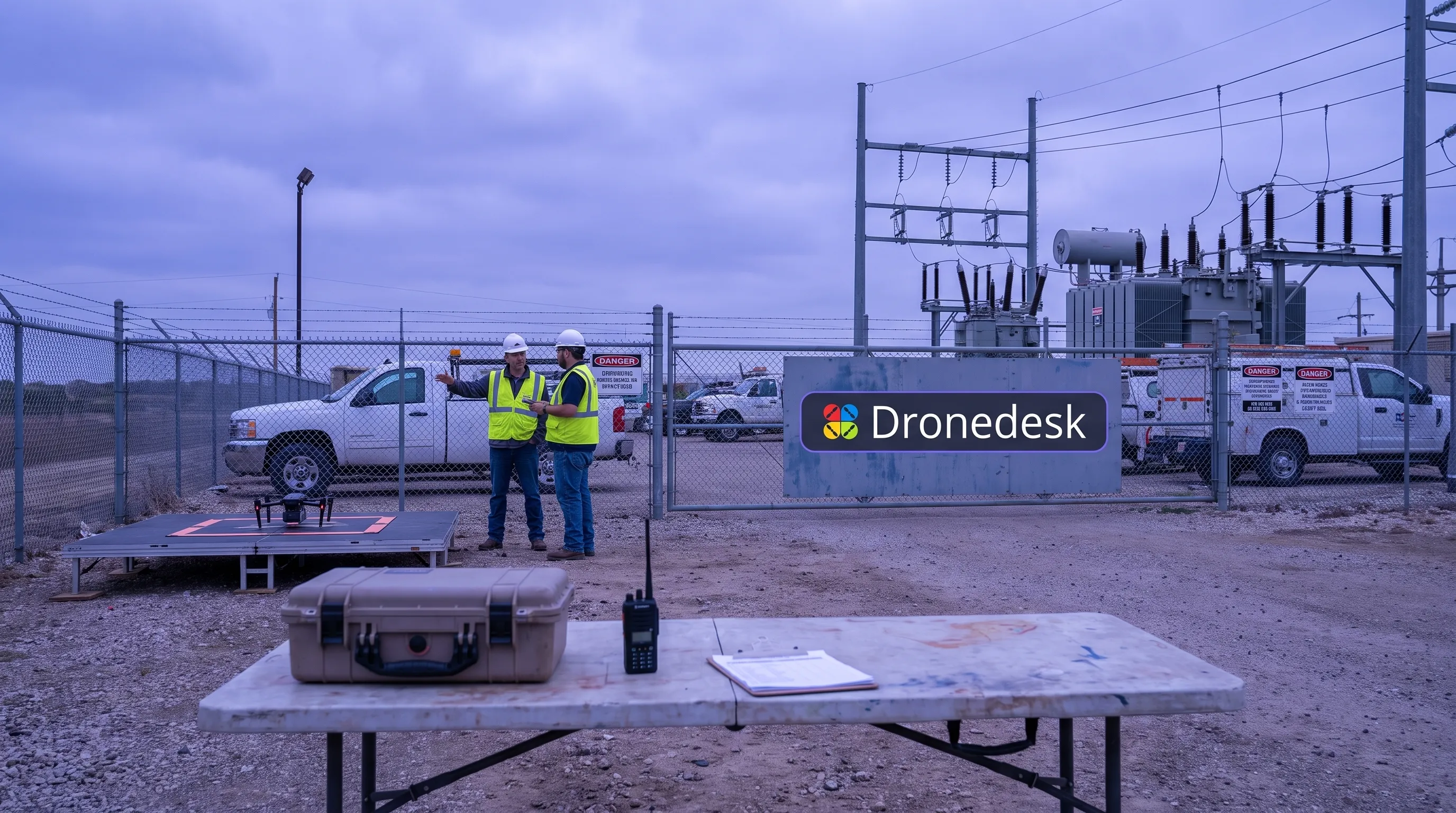 FAA Drone Pilot License: A Manager’s Compliance Checklist →
 Part 107 Classes: How to Choose Training That Fits Your Role →
 Drones for Commercial Use: How to Match Aircraft to Risk →
 Weather App for Drone Flying: Checks Beyond Wind Speed →
 How to Assess a Drone Flying Conditions App Before a Mission →
 How to Compare a Drone Flying Weather App for Site Teams →