
When Should You Retire a Commercial Drone?
A commercial drone should be retired when you can no longer demonstrate that it is safe, dependable and fit for its assigned work, or when keeping it operational no longer makes financial sense. Age and flight hours help inform that decision, but neither provides a universal expiry date.
For survey teams, utility operators and emergency services, the useful distinction is between an aircraft that needs maintenance and one that should leave operational service permanently. This guide explains how to make that distinction using condition, performance, support availability and operating costs, without inventing a fixed lifespan.
Retire, repair or temporarily ground?
Grounding is an immediate operational decision. Retirement is a longer-term asset decision. A fault can justify stopping flights without proving that the entire aircraft needs replacing.
Use the following framework to separate those decisions:
| Finding | Immediate response | Longer-term decision |
|---|---|---|
| Suspected structural damage or unexplained loss of control | Remove from service pending assessment | Repair only if an appropriate assessment supports a return to service |
| A damaged or degraded removable battery | Withdraw the affected battery | Assess the aircraft separately rather than automatically retiring it |
| A repairable component fault | Ground the aircraft and investigate | Compare an appropriate repair with replacement |
| Repeated failures after corrective work | Stop treating each incident in isolation | Investigate the underlying cause and consider retirement |
| Reliable aircraft that no longer meets the mission requirement | Remove it from that assignment | Redeploy only if suitable for another defined role |
| Essential parts or technical support are unavailable | Review whether continued operation remains supportable | Plan retirement if dependable maintenance cannot be sustained |
The retirement decision for a commercial drone should therefore answer two questions: can you establish its continued suitability, and is doing so worth the cost? Financial analysis comes second. A cheaper aircraft is not an acceptable choice if its condition remains uncertain.
Condition changes that should stop the next flight
Structural damage and uncertain repair history
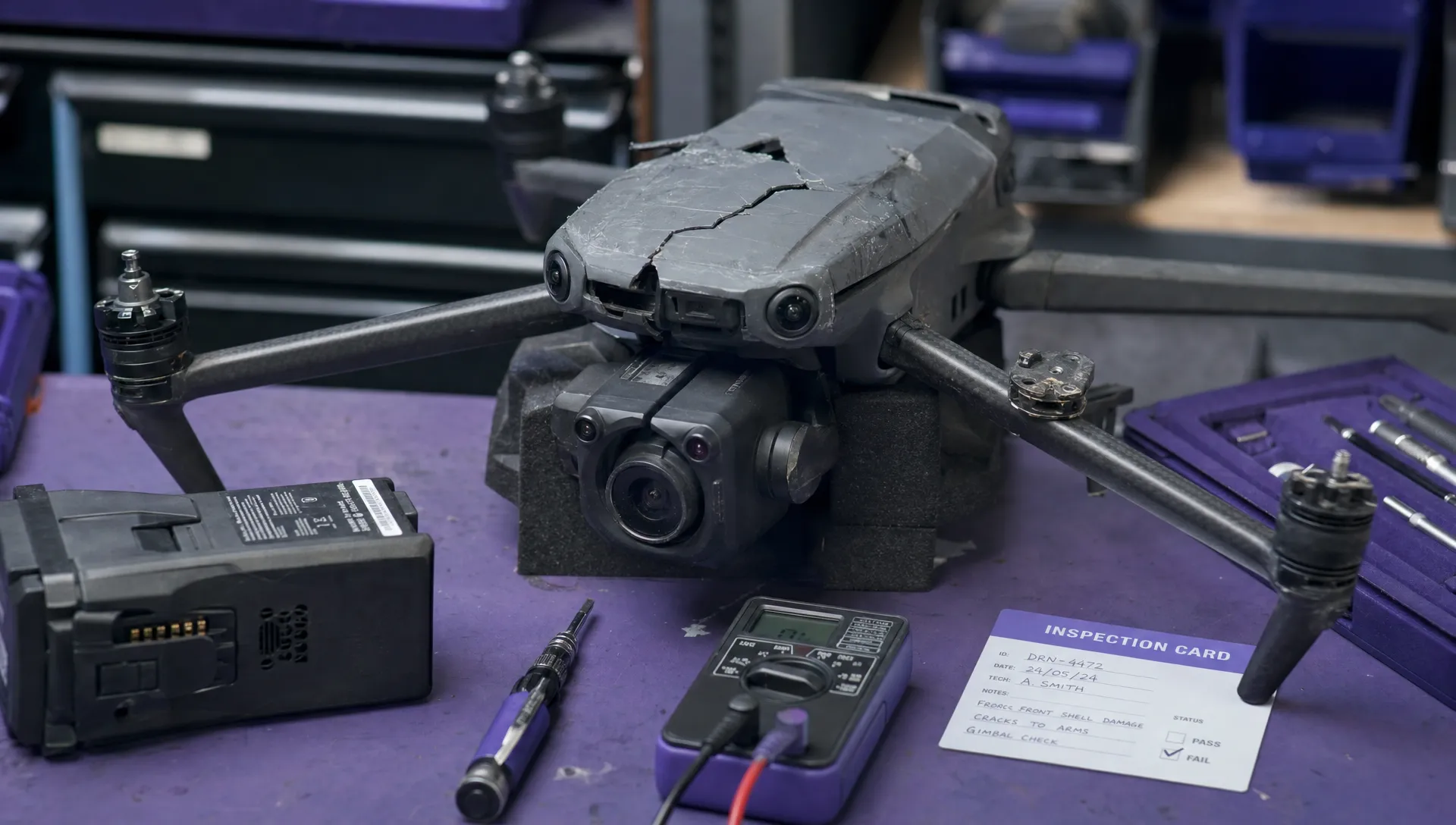
Cracks, distorted arms, damaged attachment points and loose assemblies warrant investigation before further use. Following a crash, hard landing or significant impact, visible damage may not tell the whole story.
An aircraft that powers on normally has not necessarily passed a meaningful condition assessment. Similarly, replacing a visibly damaged propeller does not establish that the motor mount or surrounding structure is sound.
Use the manufacturer's inspection and maintenance instructions, with competent technical assessment where necessary. For example, DJI publishes model documentation through its Matrice 350 RTK downloads page.
If the extent of damage cannot be established, or an appropriate repair route is unavailable, keeping the aircraft grounded is more defensible than relying on a successful hover test.
Battery deterioration is not automatically aircraft retirement
Batteries and airframes have different service histories. A battery can become unsuitable while the aircraft remains serviceable, so record and assess them separately.
Relevant warning signs include swelling, physical damage, unusual heating, charging faults and persistent imbalance where the battery system reports it. A consistent reduction in usable endurance also deserves investigation, particularly when it compromises the reserve needed for the mission.
Do not use a flight to test a battery already suspected of being unsafe. Follow the manufacturer's handling guidance and use an appropriate battery collection or disposal route.
For a commercial drone, comparing endurance only makes sense when payload, temperature, wind and mission profile are reasonably comparable. A shorter flight on a cold, windy day does not by itself establish battery failure.
Battery replacement may restore capability, but recurring power anomalies involving different serviceable batteries suggest a wider problem that needs investigation.
Recurring faults and intermittent behaviour
Intermittent faults are easy to underestimate because they may disappear during a brief check. Repeated positioning anomalies, unexplained attitude changes, abnormal vibration or communication failures deserve a documented investigation.
The aircraft is not always the cause. Environment, interference, controller equipment, configuration and operating technique can contribute.
Nevertheless, repeated unexplained behaviour creates an evidence gap. If corrective work does not resolve the issue and you cannot establish dependable operation, retirement becomes a reasonable option. Repeatedly clearing warnings without understanding them is not a maintenance strategy.
Judge the aircraft against the work it must deliver
An aircraft can remain flyable while becoming unsuitable for a particular contract or operational role.
For surveying, assess the delivered dataset rather than simply whether the mission completed. Persistent image blur, inconsistent coverage or results that fail your independent accuracy checks may indicate a payload, calibration, workflow or aircraft problem.
Utility inspection teams should consider whether the platform still produces the detail needed to identify defects reliably. Emergency services may place greater weight on deployment reliability, usable endurance with the required payload and predictable availability.
A commercial drone that meets a less demanding task can sometimes be reassigned instead of discarded. That reassignment needs a defined mission and documented acceptance criteria, not an informal label such as “backup aircraft”.
Distinguish capability limitations from faults. A camera that cannot resolve a required defect may be functioning correctly, whereas unstable imagery caused by a damaged gimbal requires investigation. Neither problem is solved merely by moving the aircraft to another team.
Support availability can shorten a useful service life
Hardware condition is only part of the picture. Continued operation also depends on access to suitable batteries, replacement parts, repair expertise and a functioning software workflow.
Review whether you can still obtain the components you actually need. The existence of second-hand parts does not necessarily provide a dependable supply, a known service history or a suitable repair route.
Check the complete workflow too: controller, operating system, mission-planning application, payload software and data-processing tools. A working airframe has limited operational value if essential components of that workflow no longer function together.
Unsupported software is not automatically evidence that an aircraft is unsafe. However, unresolved faults, security concerns or compatibility failures can make continued use inappropriate for a particular organisation or client.
For each commercial drone approaching the end of manufacturer support, set a review date and identify the replacement lead time. This gives you time to assess alternatives before a single unavailable component turns planned replacement into an urgent purchase.
Use commercial drone records to build the decision
A retirement review should combine inspection findings, maintenance history, operational incidents and delivered results. Flight count alone leaves too much unexplained.
Look for patterns across comparable missions. Useful evidence includes repeated warnings, changes in usable endurance, aborted jobs, component replacements and faults that return after repair. Record what changed, what action was taken and whether the action resolved the problem.
When examining DJI records, Dronedesk's DJI flight log analysis tool provides a starting point for flight log analysis. Treat telemetry as one source of evidence, not proof that an aircraft is structurally sound. Logs cannot rule out every crack, corrosion problem or payload defect.
A retirement review is also easier when records identify the exact aircraft and battery involved. Otherwise, a fault associated with one battery can be incorrectly attributed to the whole fleet.
For teams formalising this process across multiple aircraft, the drone fleet management guide provides broader context. Here, the objective is narrower: establish whether this particular asset should remain available for its assigned work.
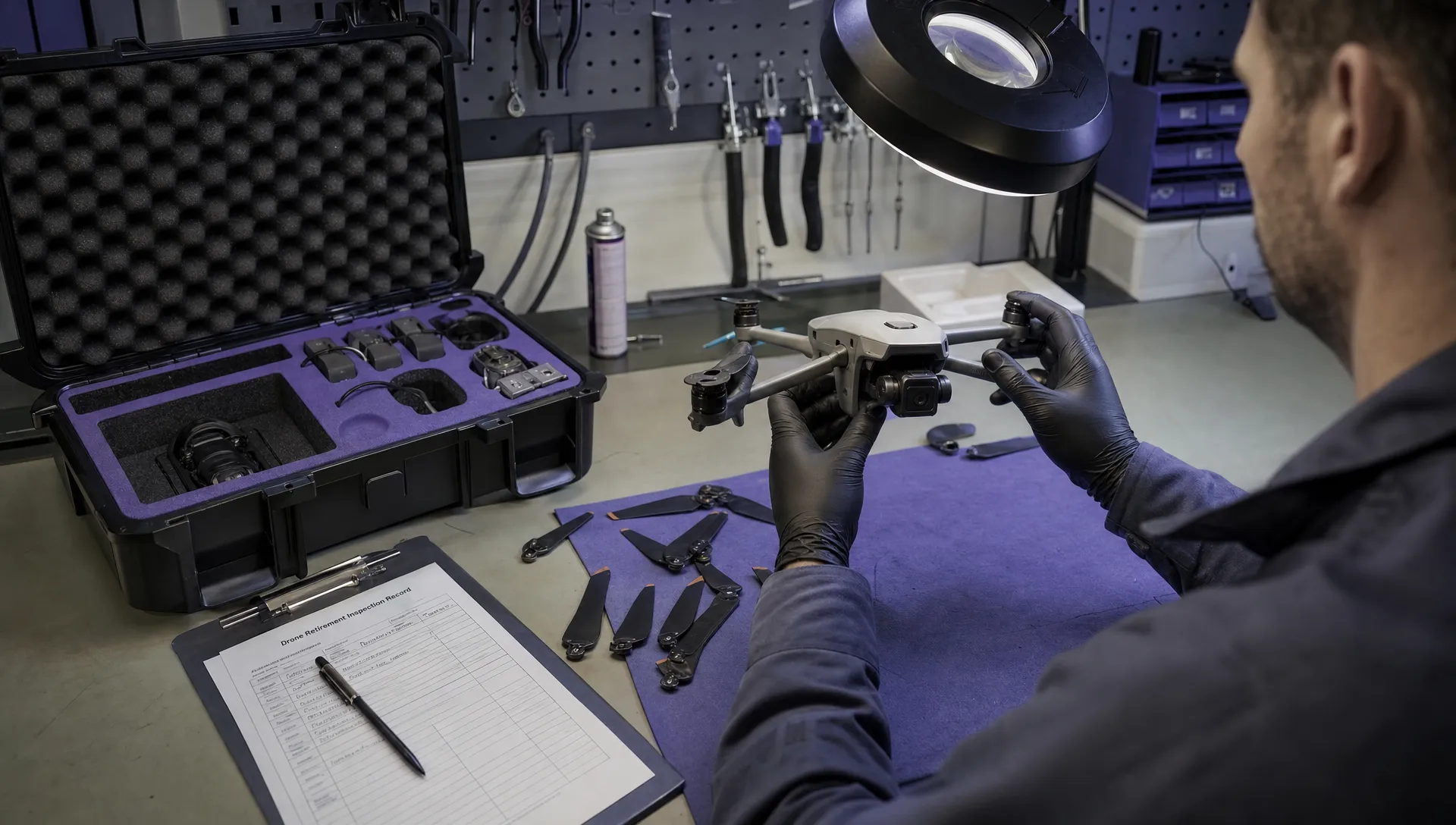
Compare the full cost of keeping and replacing
Once continued operation is technically supportable, compare the options over the same planning period. Twelve months may suit an annual budget, but a longer period can be more useful for an aircraft with substantial remaining capability.
The cost of keeping an aircraft includes more than its next repair invoice. Consider expected maintenance, parts, repeat mobilisation, replacement hire and lost contribution from work you genuinely cannot recover.
Replacement costs include acquisition, required accessories, onboarding, workflow validation and the expected operating costs of the new platform. Account for resale or trade-in value and, where relevant, the remaining asset value at the end of the comparison period.
Avoid counting the same loss twice. If replacement hire lets you complete a job, do not also count the full job revenue as lost. Equally, lost revenue is not the same as lost profit contribution.
For a commercial drone with recurring faults, a low repair quote can conceal an expensive operating pattern. One cancelled inspection may require another site visit, another access arrangement and additional staff time.
Use realistic scenarios rather than false precision. Compare a reasonable case with a worse-but-plausible case, then identify what would change the decision. If replacement only makes sense under highly optimistic assumptions, the financial argument is weak.
Cost should choose between technically acceptable options, not justify continued use of an unresolved safety concern.
Make the decision repeatable
Document any return-to-service decision
If the aircraft is repairable, record the defect, corrective work and evidence supporting its release. Define checks appropriate to the fault and follow the manufacturer's instructions, with specialist assessment where needed.
A successful test flight alone should not override unresolved structural or electrical concerns. For mission-specific problems, validate the output as well as the flight behaviour. A mapping platform needs acceptable survey results, not just stable hovering.
Set a follow-up review where uncertainty remains within an otherwise supportable operating decision. The review should have a measurable trigger, such as recurrence of the same warning or failure to meet a defined output requirement, rather than a vague promise to “keep an eye on it”.
Record retirement and prevent accidental reuse
When retirement is the appropriate decision, make the status unmistakable. Remove the aircraft from operational allocation, identify it physically and assign responsibility for its next destination.
A commercial drone retirement record should contain:
- The aircraft identity and relevant configuration.
- The reason for retirement and supporting evidence.
- The decision date and responsible person.
- The intended destination, such as assessment, resale, parts recovery or recycling.
- The status of batteries, payloads and other separately managed components.
Retain maintenance and operational records according to your organisation's retention policy. Before resale or disposal, review stored imagery, removable media, account connections and any recoverable sensitive information.
Do not present an aircraft with unresolved faults as ready for operational use. Reusable components need their own condition assessment, and batteries should follow an appropriate collection route rather than general waste disposal.
Frequently asked questions
How many flight hours should a drone last? There is no universal flight-hour limit that applies across all aircraft. Use the model's maintenance instructions alongside condition, operating environment and service history. Any published component limits should be treated separately from assumptions about whole-aircraft lifespan.
Should you retire a commercial drone after a crash? Not automatically, but it should remain out of service until the damage has been appropriately assessed. Retirement is justified where a suitable repair is unavailable, its condition cannot be established or restoring it is uneconomic.
Does replacing the batteries reset the aircraft's lifespan? No. New batteries do not reverse wear, impact damage or deterioration elsewhere. They may restore endurance if the batteries were the limiting factor, but the airframe, propulsion system, payload and supporting equipment still need assessment.
Can an ageing aircraft become a backup? Yes, if it remains suitable for a clearly defined role. A backup needs the same evidence of serviceability as an aircraft used regularly. Storage alone does not maintain its readiness.
Put the review into your fleet process
Set retirement review triggers before an aircraft fails: significant damage, recurring faults, declining mission performance, shrinking support availability and rising operating costs.
If you are reviewing how to organise the wider operation, compare your requirements with Dronedesk's published features. Keep the retirement decision evidence-led: a newer aircraft is not automatically necessary, and an older one is not automatically worth keeping.
 When Should You Retire a Commercial Drone? →
 Drone Fleet Management Software - The Platforms That Failed, and the Ones Still Flying →
 FAA Drone Pilot License: A Manager’s Compliance Checklist →
 Part 107 Classes: How to Choose Training That Fits Your Role →
 Drones for Commercial Use: How to Match Aircraft to Risk →
 Weather App for Drone Flying: Checks Beyond Wind Speed →
 How to Assess a Drone Flying Conditions App Before a Mission →
 How to Compare a Drone Flying Weather App for Site Teams →
 Drone Flight Software: A Buyer’s Guide for Multi-Site Work →
 BVLOS Drone License: Understanding the US Approval Path →